



What if your home’s most significant architectural statement isn’t the facade itself, but the ground upon which you arrive? In Swansea, where urban space is often at a premium, many residents find their property’s potential stifled by a driveway that feels dated or purely functional. You likely understand that a first impression is formed in seconds; yet, limited frontage often leads to aesthetic compromises that diminish a home’s intrinsic value and curb appeal.
This 2026 guide promises to transform that perspective by showcasing how bespoke tarmac driveway ideas for small houses can serve as a catalyst for local regeneration. Research from 2024 property market reports suggests that a meticulously designed entrance can increase a home’s valuation by up to 10 percent, making it a sound investment in your property’s long-term legacy. We will explore how visionary design can elevate a compact entrance into a prestigious asset that honors Swansea’s unique architectural heritage. From sustainable drainage systems that exceed local planning requirements to high-end finishes that mirror the city’s coastal elegance, you’ll discover the exact steps to create a low-maintenance, sophisticated gateway that reflects your commitment to quality.
Key Takeaways
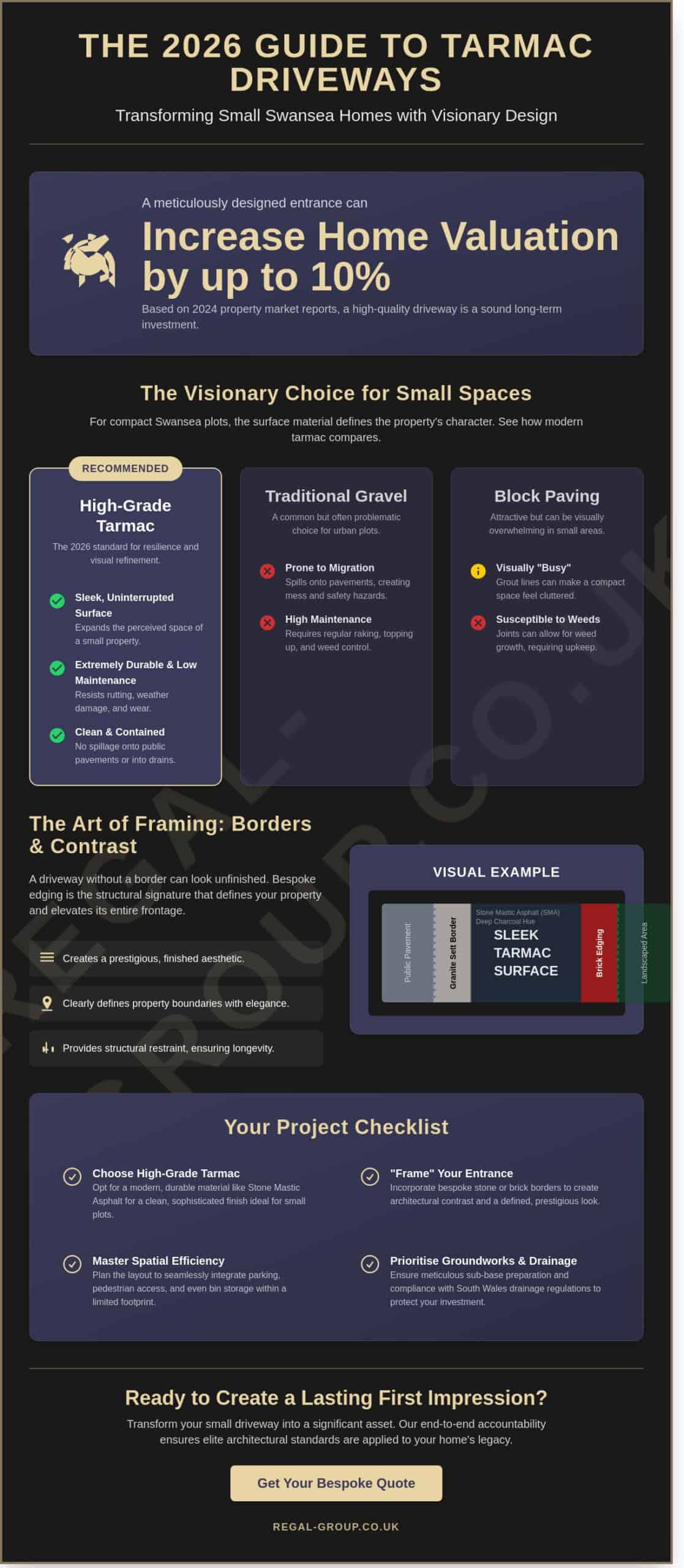
- Discover why high-grade tarmac serves as a visionary choice for urban regeneration, offering a cleaner and more durable alternative to traditional gravel in compact Swansea plots.
- Learn the art of “framing” your entrance by pairing dark tarmac with bespoke stone or brick borders to create architectural contrast and a prestigious, finished aesthetic.
- Master spatial efficiency with innovative tarmac driveway ideas for small houses that seamlessly integrate car parking, bin storage, and pedestrian access within limited square footage.
- Gain essential insights into navigating South Wales drainage regulations and the meticulous sub-base groundworks required to protect your investment against the local climate.
- Understand how applying elite architectural standards and end-to-end accountability can transform a functional driveway into a significant contribution to your home’s legacy.
Elevating Curb Appeal: Why Tarmac is the Visionary Choice for Small Swansea Homes
The regeneration of South Wales’ urban landscape begins at the threshold of the home. In Swansea, where space is a premium commodity, the choice of surfacing material defines the character of an entire street. High-quality tarmac is no longer merely a functional necessity; it’s a sophisticated tool for modern urban renewal. For homeowners exploring tarmac driveway ideas for small houses, this material offers a level of refinement that gravel or traditional paving often fails to achieve in restricted plots.
Compact urban driveways require a surface that doesn’t migrate or clutter the visual field. Gravel frequently spills onto public pavements, creating a maintenance burden and a safety hazard. Paving, while attractive, can feel busy and claustrophobic in small areas. Tarmac provides a sleek, uninterrupted plane that expands the perceived boundaries of a property. While often colloquially termed tarmac, the modern industry standard involves sophisticated Asphalt concrete, a material engineered for both resilience and visual refinement.
The Aesthetic Versatility of 2026 Tarmac
Modern surfacing has moved far beyond the utilitarian black of previous decades. In 2026, the trend focuses on charcoal and deep slate grey hues that harmonize with the natural stone found across the Gower and Swansea Bay. These sophisticated tones provide a minimalist backdrop, allowing architectural features and bespoke landscaping to take center stage. Stone Mastic Asphalt (SMA) Tarmac is the 2026 standard for residential durability, providing a resilient, high-performance finish that resists rutting and weather damage.
Complementing Swansea’s Architectural Heritage
Swansea’s architectural identity is a rich tapestry, from the ornate Victorian terraces of Uplands to the sturdy post-war semi-detached homes in Sketty. Tarmac offers the unique ability to create visual continuity between the historic streetscape and private property. For homes with limited front garden depth, a seamless transition is essential. By using tarmac driveway ideas for small houses that incorporate brick borders or granite setts, homeowners can honor local heritage while embracing modern performance. This approach ensures the driveway feels like an extension of the home’s history rather than a modern intrusion.
Bespoke Bordering and Textural Contrast: Framing Your Small Driveway
A compact driveway often risks appearing like an unfinished industrial afterthought if it lacks a defined perimeter. Within the scope of tarmac driveway ideas for small houses, the border serves as a vital structural signature. It distinguishes your private residence from the public highway, creating a sense of arrival. In Swansea’s dense terraced rows, these borders define ownership and boundaries without the need for imposing walls that often make a small space feel claustrophobic. Precision in the transition zones ensures that the dark, sleek tarmac meets the edging with architectural exactness, preventing the frayed edges that compromise many standard installations.
The role of contrast is central to this design philosophy. Pairing the obsidian depth of fresh tarmac with light-coloured stone creates a visual “pop” that elevates the entire frontage. This isn’t just about aesthetics; it’s about intentionality. A well-framed driveway tells the story of a home that is cared for, managed, and designed with a visionary eye for detail. The craftsmanship involved in laying these borders determines the longevity of the installation, as the edging acts as a literal restraint for the tarmac layers during the compaction process.
Premium Edging Materials for a High-End Finish
- Granite setts: These represent the gold standard for prestigious homes in South Wales. Their natural grey and silver tones provide a timeless, high-contrast frame that resists weathering for decades.
- Block paving borders: Utilizing multi-tonal blocks allows for intricate patterns, such as a double-course of charcoal and brindle, adding a “designer” feel to even the smallest single-car spaces.
- Natural stone vs. concrete: While concrete kerbing is a functional choice, natural stone offers a significantly higher return on visual impact. It ages gracefully, developing a patina that concrete cannot replicate.
Before finalizing your material choice, it’s vital to reference the UK government guidance on permeable surfacing to ensure your project meets SuDS (Sustainable Drainage Systems) requirements. This is particularly important in Swansea, where high rainfall necessitates meticulous drainage planning.
Visual Expansion Techniques
Strategic design can trick the eye into perceiving more space than truly exists. “Runway” borders, which consist of parallel lines of lighter stone running from the pavement toward the house, draw the eye forward and make a short driveway appear longer. Alternatively, the “Picture Frame” effect utilizes a thick, three-course border to encapsulate the tarmac. This turns a small parking patch into a deliberate piece of urban art. You can also use subtle colour shifts to define dedicated walkways within a single-car parking space. This level of bespoke craftsmanship ensures your property stands out as a beacon of quality in the neighbourhood, proving that limited dimensions are no barrier to luxury.
Strategic Spatial Design: Maximising Every Square Metre
Regal Group approaches every project with a visionary lens, recognizing that a driveway is more than a utilitarian slab; it’s the threshold to your sanctuary. For homeowners exploring tarmac driveway ideas for small houses, success lies in the Multi-Zone methodology. We engineer layouts that accommodate a vehicle, a discreet bin store, and a clear pedestrian path within a compact 20 square metre footprint. This spatial efficiency is achieved through meticulous groundworks that eliminate dead space, ensuring every corner serves a purpose. By adhering to UK government guidance on driveway surfacing, we balance aesthetic ambition with environmental integrity, focusing on sustainable drainage solutions that protect your property and the wider Swansea landscape.
Integrating nature into a tarmac-dominant front garden requires a bespoke touch. We often incorporate narrow, linear planting beds or integrated stone planters that soften the industrial edge of the asphalt. These green pockets don’t just add visual prestige; they contribute to local biodiversity and help manage surface water runoff. Our philosophy focuses on designing for the way you actually live, ensuring the transition from the pavement to your front door is seamless, intuitive, and beautiful.
Integrated Bin and Bike Storage
Clutter is the enemy of small-scale elegance. Our designs feature recessed tarmac zones specifically sized for modern, timber-clad storage units. These areas are strategically positioned behind low-level borders to hide utility items from the primary sightline of the home. It’s essential to maintain level thresholds across these zones to ensure effortless accessibility for all residents, making the movement of heavy bins or bicycles simple and safe. This level of detail ensures that practical necessities don’t compromise the architectural integrity of your home’s exterior.
Lighting for Prestige and Safety
Lighting is a transformative tool that makes a modest plot feel expansive and secure. We recommend recessed LED uplighters installed directly into the tarmac borders to create a high-end, architectural glow after dark. While solar options offer convenience, hardwired systems provide superior reliability in Swansea’s coastal environment, where salt air and high winds can challenge lesser components. This thoughtful illumination provides a sense of safety while highlighting the clean lines of our craftsmanship, ensuring your tarmac driveway ideas for small houses deliver a lasting impression at any hour.
Navigating Local Standards: Durability, Drainage, and Planning in South Wales
The Welsh climate presents a unique set of challenges for any architectural endeavour. In Swansea, where annual rainfall often exceeds 1,100mm, the success of your project rests entirely on what lies beneath the surface. Sub-base preparation isn’t merely a preliminary step; it’s the most critical stage of the construction process. Without a meticulously engineered foundation, even the most visually striking tarmac driveway ideas for small houses will succumb to the elements within a few seasons. We treat every plot as a contribution to the city’s urban legacy, ensuring the groundworks provide a stable, permanent anchor for your home.
Many homeowners express concern that tarmac might crack during a harsh winter or soften under the summer sun. These issues are almost always the result of inferior installations rather than the material itself. Modern tarmac mixtures with high bitumen content offer superior weather resistance, remaining flexible enough to accommodate thermal expansion while maintaining structural integrity. By utilizing an in-house team for every stage of the project, we guarantee that the groundworks integrity isn’t compromised by third-party contractors who might overlook the specific needs of the local terrain.
Drainage Solutions for Small Urban Plots
Managing surface water is both a legal requirement and a matter of civic responsibility. Since January 2019, Welsh legislation has mandated that all new developments over 5 square metres must include Sustainable Drainage Systems (SuDS) approved by the local SAB (SuDS Approval Body). For compact urban plots, we implement bespoke solutions like Aco drains and deep-bore soakaways. These systems ensure that heavy downpours don’t overwhelm public pavements or compromise your property’s damp-proof course. You can opt for permeable tarmac or traditional surfacing paired with strategic gradients that direct runoff into discreet filtration zones.
Durability in the Coastal Environment
Properties in areas like Mumbles or Langland face a constant barrage of salt air and high humidity. This environment accelerates the degradation of low-quality materials. Our commitment to craftsmanship means we never skip the vital foundation layers required for the heavy clay soils prevalent across South Wales. While “cheap” quotes often suggest a thin layer of stone, a durable installation requires a substantial Type 1 sub-base, typically 150mm to 200mm deep. This depth prevents the “sinking” effect often seen in driveways that weren’t built to endure the local geology. Incorporating professional tarmac driveway ideas for small houses ensures your home remains both functional and prestigious for decades.
The Regal Group Legacy: Crafting Prestigious Tarmac Entrances
We believe that a home’s entrance is its handshake with the street. For small houses in Swansea, this first impression carries immense weight. Choosing the right tarmac driveway ideas for small houses shouldn’t mean compromising on the elite standards usually reserved for sprawling country estates. Our legacy is built on the conviction that every square metre of tarmac is a piece of urban art. We apply the same architectural precision to a compact terrace as we do to a multi-million pound development. It’s about regeneration. It’s about local pride.
Our approach is fundamentally bespoke. We don’t believe in “off-the-shelf” solutions because every property has a unique story and a specific architectural heritage. By treating small spaces with visionary design, we transform standard driveways into prestigious landmarks. This level of craftsmanship ensures your home doesn’t just blend into the neighbourhood; it sets a new standard for the street’s aesthetic future.
Our In-House Commitment
We maintain total control over every project by refusing to use subcontractors. This ensures the Regal Group standard is upheld from the first spade in the ground to the final pass of the heavy roller. Our team lives and works in Swansea; we’re invested in the city’s urban fabric and the longevity of its communities. When we arrive at your property, we operate with a professional efficiency that respects your time and your neighbours’ peace.
- Total Accountability: From initial groundworks to the precision finish, one team is responsible for your masterpiece.
- Swansea Focus: We understand local soil conditions and drainage requirements specific to the South Wales coast.
- Professional Execution: Expect a clean, contained site and a process that prioritises safety and minimal disruption.
Your Next Steps to Curb Appeal
Limited dimensions often hide untapped potential. Our designers specialise in identifying these opportunities, ensuring your tarmac driveway ideas for small houses maximise both utility and aesthetic impact. While a quick-fix contractor might offer a lower initial price, a Regal Group installation represents a long-term investment in your property’s valuation. We focus on durability and sustainable drainage, preventing the common cracks and puddles that plague inferior work.
Your journey toward a transformed exterior begins with a conversation about your vision and ends with a masterpiece that stands the test of time. We take pride in our end-to-end involvement, providing a seamless transition from a conceptual drawing to a physical reality that enhances your daily life. It’s time to elevate your home’s presence with the integrity and excellence it deserves.
Elevate Your Swansea Residence with Visionary Design
Small urban plots in South Wales require more than just a surface; they demand a calculated blend of spatial intelligence and aesthetic prestige. By integrating SuDS-compliant drainage solutions and bespoke stone bordering, these tarmac driveway ideas for small houses turn tight footprints into expansive architectural statements. Regal Group brings over 10 years of specialist landscaping experience to every project, ensuring your entrance meets the rigorous 2026 standards for durability and environmental responsibility. We don’t rely on subcontractors; instead, our dedicated in-house Swansea team manages every detail from the initial vision to the final pour. This total ownership guarantees a finish that reflects the integrity of your home while contributing to the wider regeneration of our coastal community. It’s about creating a legacy that starts at your front door. Your home deserves a transition that is as functional as it is beautiful, blending modern innovation with the unique character of our city.
Begin your home’s transformation with a bespoke tarmac quote from Regal Group
Your property’s potential is waiting to be unlocked through precision engineering and refined craftsmanship.
Frequently Asked Questions
Do I need planning permission for a tarmac driveway in Swansea?
You won’t usually need planning permission if your driveway uses a permeable surface or directs rainwater to a lawn or border to drain naturally. Since the 2008 amendment to the General Permitted Development Order, UK homeowners must use Sustainable Drainage Systems (SuDS) for any front garden surface exceeding 5 square metres. If your project doesn’t meet these specific environmental standards, you’ll need to submit a formal application to Swansea Council.
Is tarmac or resin better for a small driveway in South Wales?
Tarmac offers superior structural integrity and cost-efficiency, while resin provides a wider variety of decorative finishes. In the South Wales climate, tarmac’s resilience against heavy rainfall makes it a practical choice for compact urban spaces. Our tarmac driveway ideas for small houses focus on achieving a bespoke, high-end look that balances functional longevity with the refined curb appeal required for modern city living.
How long does a high-quality tarmac driveway last?
A professionally installed tarmac driveway typically lasts between 15 and 20 years when maintained correctly. Its lifespan depends heavily on the quality of the sub-base construction and the precision of the installation process. By choosing high-grade bitumen and ensuring proper drainage, you’ll protect the integrity of the surface against the freeze-thaw cycles common in Swansea during the winter months.
Can I change the colour of my tarmac driveway?
You can refresh or alter the colour of your driveway using specialist bitumen-based restorative coatings. While traditional black remains a prestigious choice for its timeless sophistication, modern sealants allow for a deep charcoal finish or subtle shifts in tone. These coatings don’t just alter the appearance; they also provide a protective layer that can extend the life of the material by 5 to 10 years.
How much maintenance does a tarmac driveway require in the Welsh climate?
Tarmac requires minimal maintenance beyond regular sweeping and an occasional wash to remove organic debris. Because Swansea receives an average of 1,100mm of rainfall annually, it’s vital to ensure that moss and algae don’t accumulate in shaded corners. Applying a high-quality sealant every 3 to 5 years will preserve the deep pigment and prevent the surface from becoming brittle over time.
Will a new tarmac driveway increase the value of my small house?
A well-designed driveway can increase your property’s market value by 5% to 10% according to industry data from the Virgin Money property report. For small houses where street parking is limited, creating a dedicated off-road space is a visionary investment. It transforms the property’s exterior from a simple entrance into a sophisticated statement of quality and craftsmanship that appeals to future buyers.
What is the best way to clean a tarmac driveway without damaging the surface?
The safest way to clean your surface is with a mild detergent and a soft-bristled brush to gently lift dirt. You should avoid using high-pressure power washers at close range, as the concentrated force can dislodge the aggregate and weaken the bitumen bond. For oil spills, act within 30 minutes using an absorbent material like cat litter before washing with a specialized degreasing agent.
How long after installation can I park my car on the new tarmac?
You can usually walk on the surface within 24 hours, but you should wait at least 48 to 72 hours before parking a vehicle. During the warmer summer months, the cooling process takes longer, so it’s wise to avoid turning your steering wheel while the car is stationary for the first 14 days. This patience ensures the surface sets perfectly without scuffing or creating permanent indentations.