


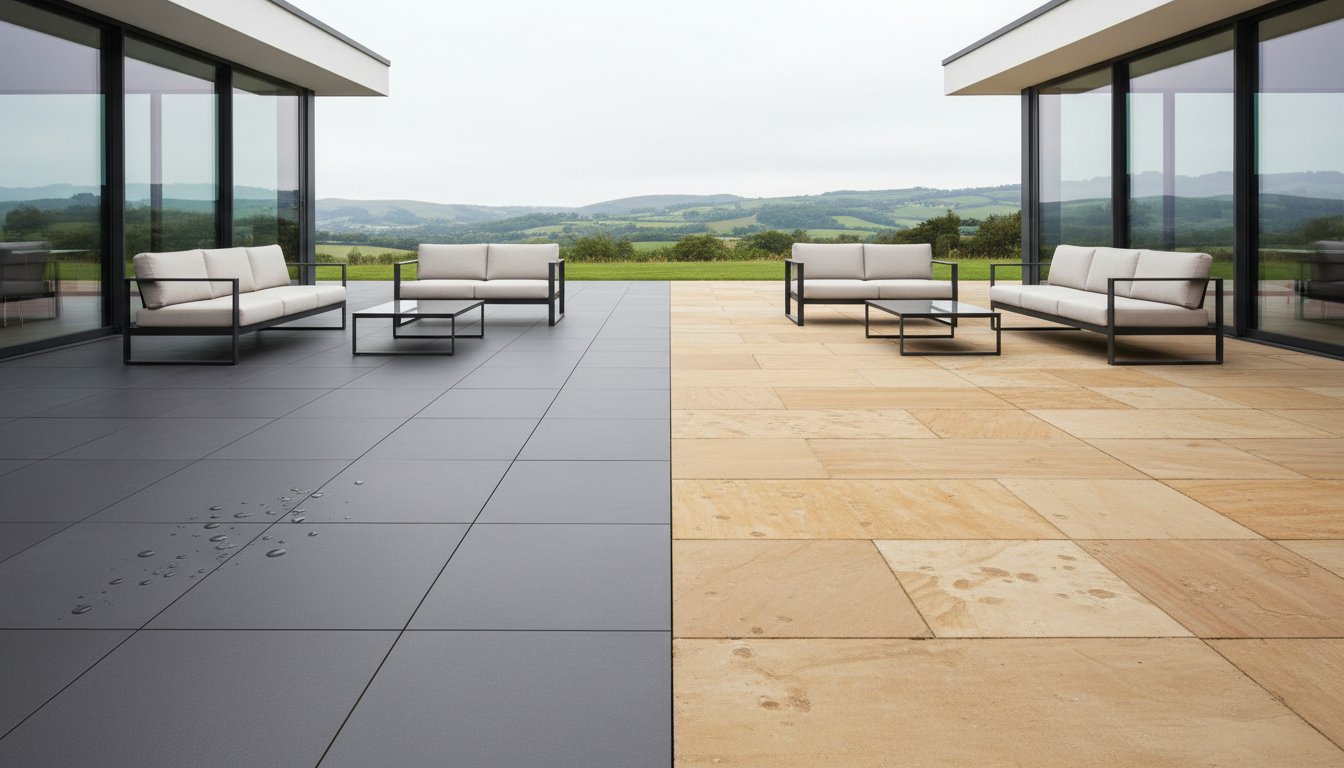
The most enduring landscape choice for your home isn’t always the one that’s been used for centuries. While natural textures define our heritage, the traditional appeal of raw stone can quickly fade under the weight of Swansea’s 1,400mm annual rainfall, turning a prestigious investment into a high-maintenance burden. Deciding between porcelain vs sandstone patios requires more than a simple aesthetic preference; it’s a visionary choice about the legacy of your outdoor living space and how it harmonizes with the architectural spirit of South Wales.
You likely believe a garden should serve as a sophisticated sanctuary rather than a constant chore, yet you’ve likely seen how quickly our damp climate compromises the elegance of a terrace with unsightly algae and treacherous surfaces. We’ve curated this definitive 2026 guide to help you distinguish between these two titans of hardscaping, promising a clear path to a bespoke, low-maintenance retreat that elevates your property’s long-term value. We’ll explore the technical craftsmanship of vitrified porcelain, the organic character of sandstone, and exactly how each material preserves its integrity against the unique environmental demands of the Gower Peninsula.
Key Takeaways
- Learn how to achieve a seamless architectural transition between your home and garden by balancing the precision of engineered porcelain with the timeless character of natural stone.
- Discover which material best withstands the high rainfall of South Wales by comparing the porosity and maintenance requirements of porcelain vs sandstone patios.
- Evaluate the investment framework of your outdoor space, focusing on how premium materials and professional installation contribute to long-term property value in the Swansea market.
- Understand the technical advantages of high-density engineered ceramics and their ability to resist common garden issues such as algae, lichen, and black spot.
- Identify the critical role of bespoke craftsmanship and in-house execution in ensuring your patio remains a visionary and enduring feature of your home.
The Evolution of the Swansea Garden: Porcelain vs Sandstone Patios in 2026
The landscape of South Wales is undergoing a profound transformation. By 2026, the concept of the traditional garden has been superseded by the ‘outdoor room’, a seamless extension of the interior living space. Swansea homeowners are increasingly investing in high-end surfacing to anchor these bespoke environments. This shift reflects a broader commitment to urban regeneration and personal legacy. Choosing between porcelain vs sandstone patios isn’t merely a functional decision; it’s an architectural statement that defines the character of a home for decades. The material you select dictates the rhythm of your daily life, the ease of your maintenance routines, and the long-term value of your property.
Porcelain represents the pinnacle of engineered surfacing. It’s a dense, vitrified ceramic produced by firing refined clays at temperatures exceeding 1,200 degrees Celsius. This rigorous manufacturing process results in porcelain tile characteristics such as near-zero water absorption and exceptional structural integrity. It offers a level of precision that mirrors the most ambitious modern developments, providing a surface that remains impervious to the fluctuating Welsh climate. It’s a visionary material for the forward-thinking homeowner.
Sandstone offers a different narrative rooted in the earth’s history. It’s a sedimentary rock formed over millions of years, capturing a unique geological record within every slab. It brings a sense of permanence and heritage to a project. While engineered materials strive for perfection, sandstone celebrates the beauty of natural variation. It presents a palette of organic tones that shift subtly with the light, ensuring that no two installations are ever identical. For those who value the artisan touch, sandstone remains an enduring favorite.
Modern Sophistication: The Rise of Porcelain
Technological progress in 2026 has pushed porcelain into a new era of realism. Digital printing now creates textures indistinguishable from natural stone or timber, offering hyper-realistic depth. For the contemporary Swansea home, porcelain provides a sharp, minimalist aesthetic. Its rectified edges allow for 2mm grout lines, creating a unified, expansive floor that’s easy to clean. It’s the premier choice for those prioritizing a low-maintenance, luxury lifestyle without compromising on visual impact.
Timeless Heritage: The Enduring Appeal of Sandstone
Natural stone remains deeply connected to the Welsh soul. Sandstone’s organic tones complement the rugged beauty of the Gower coastline and the traditional stone masonry found in Mumbles. Every patio is a singular masterpiece. It provides a tactile warmth that’s soft underfoot; a quality that synthetic alternatives often fail to capture. For a property designed to age gracefully alongside its environment, sandstone remains an unrivaled medium of craftsmanship and integrity.
Architectural Precision vs. Natural Character: An Aesthetic Comparison
Choosing between porcelain vs sandstone patios requires a balance of personal taste and architectural respect. Porcelain offers a manufactured perfection where every slab mirrors the next. It creates a refined, intentional atmosphere that feels curated rather than grown. Sandstone provides a bespoke unpredictability. No two stones are identical; each piece features unique veining and mineral deposits. This creates a garden that feels as though it has been part of the Welsh landscape for decades.
Modern homeowners often prioritize a seamless transition between their interior and exterior living spaces. Porcelain is the superior choice for this specific ambition. Its calibrated thickness allows for a flush threshold, enabling the floor level to remain constant from the kitchen to the garden. This blurs the boundary of the home. Sandstone, while beautiful, often feels like a distinct departure from the property. It acts as a rustic retreat rather than an architectural extension.
Selecting the right material also depends on your property’s history. A Victorian villa in Sketty or an Edwardian terrace in Uplands often demands the weathered charm of sandstone to respect its heritage. The stone’s natural edges and riven surface complement aged brickwork. Conversely, a contemporary coastal development in Mumbles benefits from the permanent vibrancy and clean lines of porcelain. It matches the crisp geometry of modern glass and steel. If you are planning a project that requires this level of detail, exploring bespoke landscaping solutions can help define your home’s long-term legacy.
Colour Profiles and Design Versatility
Porcelain’s manufacturing process allows for incredible range. It can replicate reclaimed timber, industrial concrete, or even rare Italian marble with 100% fidelity. These tones remain locked within the vitrified clay. Sandstone relies on the earth’s chemistry. You get the warm ochres of Raj Green or the cool, steely tones of Kandla Grey. In the soft, diffused light of South Wales, porcelain retains its original hue for decades. It doesn’t fade under UV exposure. Sandstone evolves. It gains a patina over time that many find soulful, though it lacks the ‘day-one’ consistency that porcelain guarantees.
Texture and Finish: The Tactile Experience
Safety meets style in the texture of these materials. Porcelain typically carries an R11 slip-rating, providing a fine, sandpaper-like grip that remains consistent even when wet. Sandstone offers a riven surface that is tactile and rugged. The way light interacts with these surfaces differs greatly. Porcelain reflects light evenly, which helps brighten darker corners of a Swansea garden during the winter months. Sandstone absorbs and scatters light, creating a softer, more atmospheric glow. Slab sizing also plays a role in perception. Large 1200x600mm porcelain units make small urban courtyards feel expansive, while the traditional four-size project packs used in sandstone installations create a busy, classic pattern suited to cottage aesthetics.

Performance Under Pressure: Navigating the South Wales Climate
Swansea’s architectural landscape is defined by its relationship with the elements. With the city recording an average of 1,100mm of rainfall annually, any outdoor investment must withstand consistent saturation. When debating porcelain vs sandstone patios, the primary technical differentiator is how each material interacts with moisture. This choice dictates not just the look of your garden, but its longevity and safety over the next two decades.
During the winter months, moisture trapped within the capillaries of natural sandstone undergoes a freeze-thaw cycle. Water expands by 9% when frozen; this internal pressure can lead to micro-fissures and eventual surface spalling in lower-grade stone. For homes overlooking Swansea Bay or the Mumbles, salt spray presents an additional challenge. Salt crystals can form within the pores of natural stone, causing physical weathering that porcelain simply avoids. Vitrified porcelain is chemically inert and non-porous, making it immune to the corrosive effects of coastal air and the relentless Welsh rain.
The Battle Against Algae and Maintenance
Porcelain’s manufacturing process involves firing clay at 1,200 degrees Celsius, resulting in a water absorption rate of less than 0.05%. This creates a surface where algae, lichen, and the dreaded “black spot” fungus cannot take root. While natural sandstone offers a timeless aesthetic, it requires a commitment to biennial sealing to preserve its structural integrity. Maintenance for porcelain is reduced to a simple seasonal wash with warm soapy water. Sandstone often demands intensive jet washing or specialised chemical treatments to remove organic growth that thrives in our local humidity.
Safety and Slip Resistance in Wet Weather
Ensuring family safety in a climate that sees rain on roughly 200 days a year is a non-negotiable priority. Slip resistance is measured via the R-rating system, and Regal Group exclusively installs porcelain with an R11 rating or higher for all Swansea projects. This ensures a textured surface that provides reliable grip even under heavy downpours. While sandstone naturally offers a riven texture that provides excellent traction, its performance can degrade if algae is allowed to create a slippery film over the stone. Choosing the right porcelain vs sandstone patios option involves balancing this natural grip against the long-term cleanliness of the surface.
- Porcelain: Virtually impervious to frost and salt, requiring zero specialist sealing.
- Sandstone: Requires high-quality breathable sealants to prevent water ingress and organic staining.
- Safety: R11 slip ratings are the gold standard for wet Welsh terraces and pool surrounds.
Regal Group views every patio as a legacy project. By selecting materials that respect the specific meteorological demands of South Wales, we ensure your outdoor space remains a pristine extension of your home rather than a maintenance burden. Our commitment to craftsmanship means we only recommend grades of stone and porcelain that we know will endure the test of time and tide.
The Investment Framework: Cost, Longevity, and Property Value
Groundworks represent the invisible foundation of this investment. Without a precision-engineered sub-base, even the most expensive materials will eventually succumb to the elements. Professional installation prevents “pumping,” a common failure where water trapped beneath slabs creates a vacuum that loosens the stones. We prioritise structural integrity from the first excavation, ensuring your outdoor space remains level and secure for decades. It’s not just about the stone you see, it’s about the engineering you don’t.
Installation Complexity and Groundwork Standards
Achieving a flawless finish requires technical mastery tailored to the specific material. Porcelain is a vitrified product with near-zero porosity, meaning it won’t bond to standard mortar. It requires a specialist SBR primer (slurry bond) applied to the underside of every tile to ensure a chemical fuse with the bedding layer. Sandstone, while more traditional, demands a full wet mortar bed and expert pointing to prevent moisture ingress. We adhere to the rigorous specifications found in The Authoritative Guide to Outdoor Renovation in Swansea & South Wales (2026) to guarantee that every joint and level meets our uncompromising standards of excellence.
Lifetime Value and Sustainability
The longevity of your choice defines its ultimate sustainability. Porcelain offers an engineered lifespan exceeding 30 years with virtually no degradation in appearance. Its dense structure is impervious to the salt-heavy air of the Mumbles or the Gower, making it a visionary choice for coastal living. Sandstone offers a “living” aesthetic that matures with age, though it requires periodic sealing to maintain its structural integrity against the Welsh rain. While the kiln-firing process of porcelain involves higher initial energy consumption, its 30-year durability often outweighs the carbon cost of frequent replacements. When comparing porcelain vs sandstone patios, consider how each material aligns with your long-term commitment to environmental stewardship and personal lifestyle. Homeowners planning a complete outdoor transformation may also wish to explore how composite vs timber decking can complement their new patio surface, extending the outdoor living space with a material equally suited to the demands of the Welsh climate.
Crafting Your Visionary Outdoor Space with Regal Group
Choosing between porcelain vs sandstone patios is merely the first step in a much larger journey toward architectural excellence. At Regal Group, we view your garden as a vital extension of your home’s living space, a sanctuary that requires the same level of precision as any high-end interior development. Our role is to translate your initial preference for material into a cohesive, sustainable reality that enhances the urban fabric of Swansea. We don’t just lay paving; we engineer environments that stand as a testament to quality and visionary design.
The Integrity of In-House Craftsmanship
Total ownership is the cornerstone of our philosophy. We believe that the architectural precision your home deserves can only be achieved through a dedicated, permanent workforce. By maintaining a full team of specialists, we ensure that every measurement is exact and every drainage solution is perfectly calibrated to the South Wales climate. Our no-subcontractor promise serves as an absolute guarantee that every stone laid and every joint pointed meets our rigorous internal standards for quality control. This accountability eliminates the risks associated with fragmented labor, providing you with a single, reliable point of contact throughout the regeneration of your outdoor space.
Your Next Steps in Garden Transformation
The journey toward a refined outdoor lifestyle begins with a professional consultation. Our experts are available to visit your Swansea or South Wales property to assess the site conditions and provide a detailed roadmap for your project. We analyze everything from soil composition to light exposure, ensuring your choice between porcelain vs sandstone patios is backed by technical data and aesthetic intuition. Once your patio surface is chosen, many homeowners find that exploring elegant garden pergola ideas for South Wales homes is the natural next step in creating a fully sheltered outdoor living room that can be enjoyed year-round despite the Welsh climate.
To further enhance your home’s exterior, you might consider how your new patio aligns with your property’s entrance. You can explore complementary surfacing ideas in our latest resource, The Ultimate Guide to Resin Driveways in Swansea: 2026 Edition, which details how modern resin can mirror the sophistication of your garden design. Embark on your outdoor regeneration journey today by contacting our team for a bespoke design review. It’s time to build a space that reflects your ambition and provides a lasting sanctuary for your family.
Defining the Future of Your Outdoor Sanctuary
Selecting the right material in the porcelain vs sandstone patios debate is a pivotal step in curating a garden that thrives in the 2026 landscape. Whether you prioritize the clinical precision and low-maintenance profile of porcelain or the textured, historical soul of natural sandstone, your choice dictates your home’s aesthetic legacy for decades. South Wales presents unique environmental challenges, yet our commitment to craftsmanship ensures your space remains a resilient haven regardless of the weather. Our in-house expert team maintains total accountability over every project, refusing to compromise quality by using subcontractors. We focus on bespoke designs that respect Swansea’s distinct topography, pairing visionary architecture with durable, high-end materials that are guaranteed for longevity. It’s about more than just paving; it’s about creating a sophisticated environment where life unfolds with effortless grace. Begin your garden’s transformation with a bespoke quote from Regal Group today. We look forward to shaping your vision into a lasting reality.
Frequently Asked Questions
Is porcelain more slippery than sandstone when wet?
Porcelain is generally less slippery than sandstone because it’s manufactured with a specific anti-slip texture, often carrying an R11 rating. This international standard ensures the surface provides sufficient grip even during heavy South Wales rain. While natural sandstone offers decent traction, it’s a porous material that invites algae growth; this organic film can make the stone incredibly slick if you don’t maintain it regularly.
Does sandstone paving need to be sealed every year?
You don’t need to seal your sandstone every year; a high-quality impregnating sealant typically lasts between 3 and 5 years. Applying sealant too frequently can lead to a patchy, plastic-like residue that detracts from the stone’s natural beauty. We recommend a single coat of a professional-grade breathable sealer once the initial efflorescence has cleared to protect your investment from deep-seated stains and water ingress.
Which is more expensive to install in Swansea: porcelain or sandstone?
Porcelain typically requires a higher initial investment compared to natural stone options. Current 2024 industry data indicates that a professional installation for porcelain vs sandstone patios usually ranges from £110 to £160 per square metre for porcelain, whereas sandstone averages between £80 and £120. This price difference reflects the specialized diamond blades and polymer-modified mortars required to work with such a dense, sophisticated material.
Can I use porcelain paving for a driveway as well as a patio?
You can use porcelain for a driveway provided you select tiles with a minimum thickness of 20mm or 30mm. Standard 10mm tiles designed for internal use will shatter under the weight of a vehicle. For a successful installation, you must lay the tiles on a reinforced concrete slab rather than a traditional grit sand base to ensure the surface handles the 2,000kg load of a modern SUV without shifting.
How do I remove black spots and algae from my sandstone patio?
The most effective way to eliminate black spots is to use a professional-grade cleaner containing sodium hypochlorite. These spots are actually a resilient lichen that anchors itself into the stone’s pores; a standard pressure washer won’t remove them and might even damage the stone’s surface. Applying a specialized solution typically clears 98 percent of organic growth within 24 hours, restoring the patio’s original character and vibrancy.
Will porcelain tiles crack in the winter frost of South Wales?
Porcelain tiles are completely frost-proof because they have a water absorption rate of less than 0.05 percent. Since the tiles don’t soak up moisture, there’s no water inside the material to expand and contract during the freeze-thaw cycles common in Swansea. This makes porcelain an exceptionally durable choice for our maritime climate, ensuring your outdoor space remains pristine regardless of the temperature drops in January.
How long does it typically take to install a new patio?
A standard 40 square metre patio project usually takes between 7 and 10 working days to complete from start to finish. This timeline allows for the essential groundworks, including a 100mm compacted sub-base and the meticulous laying of the slabs on a full mortar bed. If your design includes bespoke curves or complex drainage systems, you should expect the craftsmanship to require an additional 3 to 4 days of onsite work.
Can porcelain paving mimic the look of natural sandstone?
Modern high-definition inkjet technology allows porcelain to replicate the intricate veining and tonal variations of natural stone with 95 percent visual accuracy. When choosing porcelain vs sandstone patios, many homeowners opt for porcelain because it offers the rustic aesthetic of the Earth with the technical performance of an engineered product. Manufacturers now produce up to 30 unique tile faces for a single range, ensuring your patio looks authentic without repetitive patterns.