


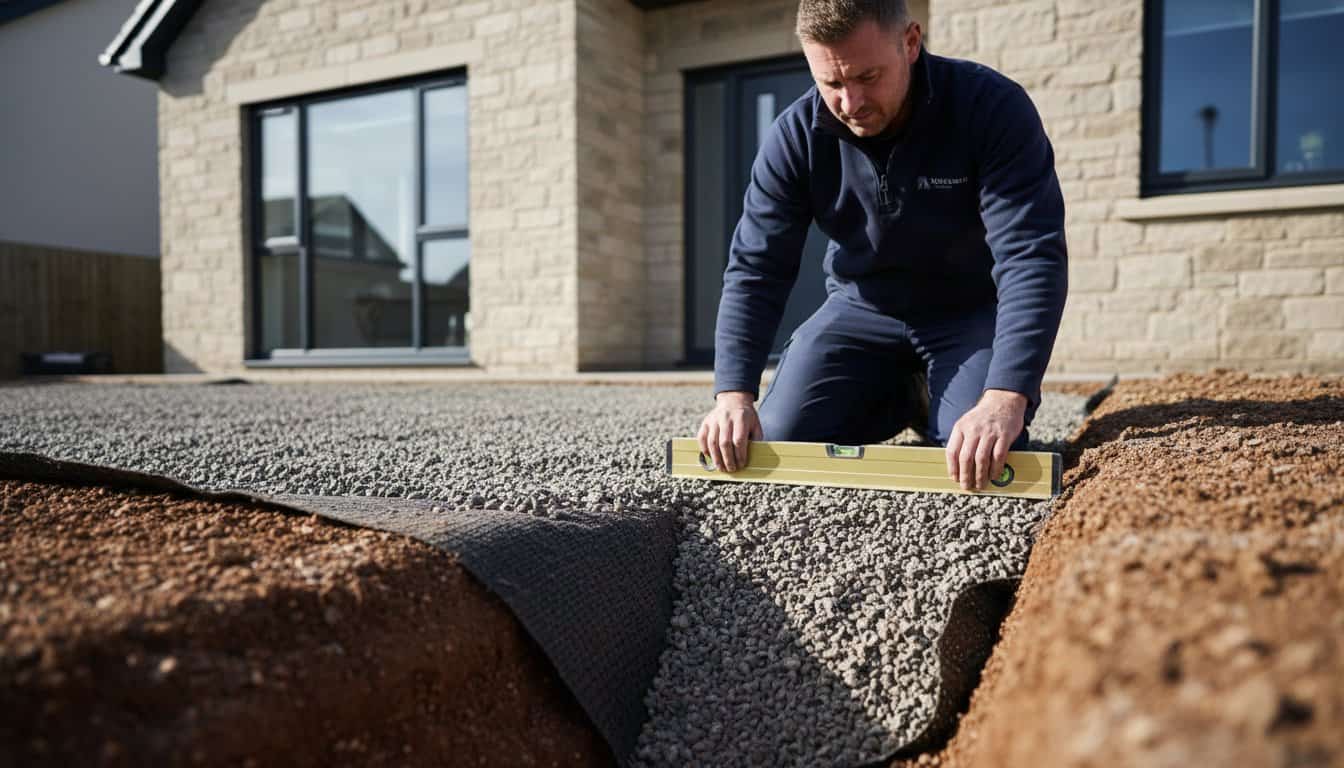
The true value of your home’s exterior isn’t found in the surface you see, but in the engineering you don’t. While most focus on the final aesthetic, professional driveway groundworks represent the silent architecture that determines whether your investment will endure or erode. It’s a sobering reality that site preparation, including excavation and meticulous layering, can account for up to 80% of a project’s total cost. This isn’t merely a preliminary stage; it’s the creation of a lasting legacy for your property.
You likely share the common anxiety that a beautiful entrance might eventually succumb to unsightly sinkage, cracks, or persistent puddling. We understand that technical terms like sub-base or MOT Type 1 can feel like a barrier to making informed decisions. This guide promises to reveal why this invisible foundation is the most critical factor in achieving a driveway that remains pristine for decades. We’ll demystify the technical layers, explore the legal necessity of Sustainable Drainage Systems (SuDS) in Wales, and provide the clarity you need to choose a partner who refuses to cut corners.
Key Takeaways
- Recognize how professional driveway groundworks serve as the essential engineering of your home’s exterior, safeguarding the stability and elegance of your investment.
- Master the technical necessity of geotextile membranes. These vital barriers eliminate the risk of structural sinking or material contamination.
- Understand why premium finishes like resin and tarmac demand bespoke foundation designs to manage drainage and environmental stressors effectively.
- Clarify the legal requirements for Sustainable Drainage Systems (SuDS) to ensure your project aligns with modern environmental standards and local regulations.
- Appreciate the value of total ownership. This internal commitment ensures a seamless transition from initial excavation to the final, polished surface.
Understanding Driveway Groundworks: Why the Foundation Dictates the Future
Excellence is rarely superficial. While the eye is naturally drawn to the textures and tones of common driveway materials, the longevity of your home’s entrance depends entirely on the hidden engineering beneath. We define driveway groundworks as the comprehensive technical preparation that occurs long before the first stone is laid. It’s an intricate process of excavation, stabilization, and drainage management that transforms a patch of earth into a resilient structural platform. Without this phase, even the most expensive surface is destined for failure.
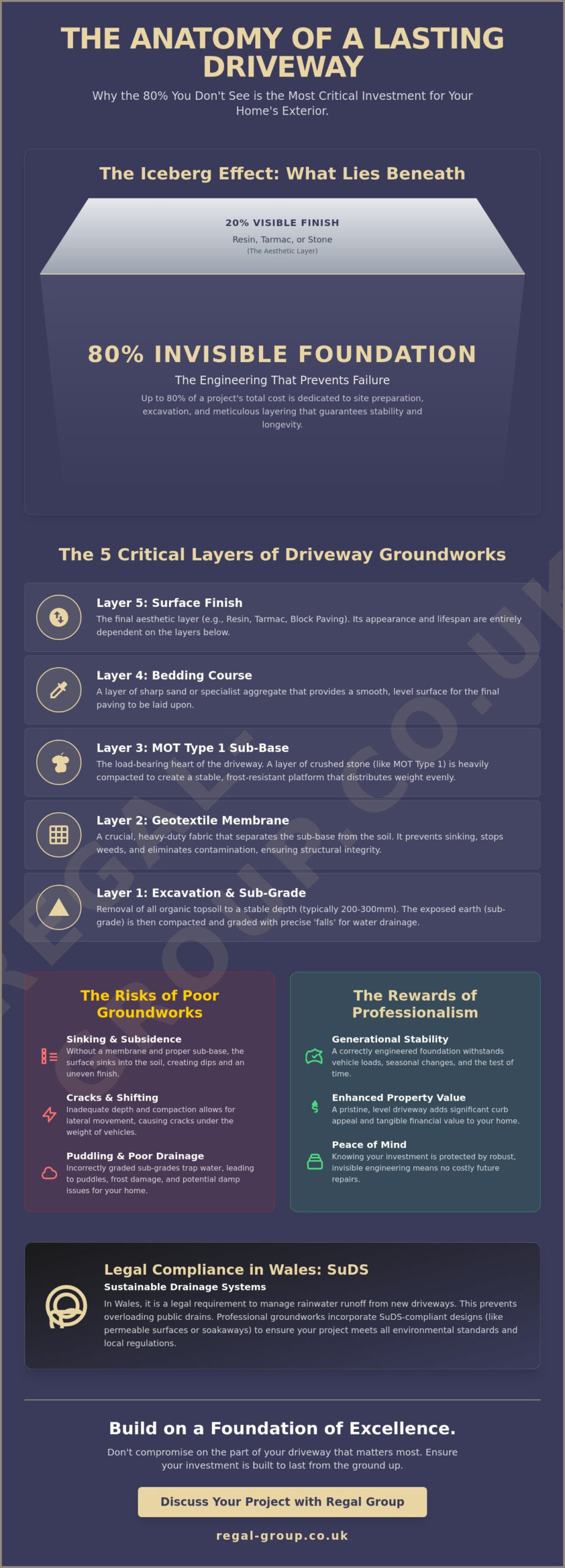
Consider the ‘iceberg effect’. In a professional installation, approximately 80% of the total effort and material volume remains entirely invisible once the project is complete. This hidden majority is what dictates the future of your property’s curb appeal and structural integrity. In Swansea and the surrounding South Wales region, where the landscape is as demanding as it is beautiful, the relationship between foundational depth and long-term property value is direct. A driveway that remains level and pristine for decades adds tangible prestige; a driveway that sinks or shifts becomes a liability that detracts from your home’s worth. Skipping these steps leads to lateral shifting and subsidence, turning a significant investment into a costly repair project.
The Invisible Investment in Your Property
Think of groundworks as a safeguard for your financial investment. Many homeowners are tempted by ‘overlay’ methods, which involve simply pouring new material over an existing, failing surface. This approach is fundamentally flawed. True craftsmanship requires a legacy mindset. By committing to deep-earth preparation, you’re building an entrance designed to last for generations. Professional excavation ensures that organic matter is removed, preventing the internal decay that leads to the voids and dips seen in inferior projects. This isn’t just a construction phase; it’s the creation of a permanent architectural feature.
Why ‘Good Enough’ is Never Enough
Soil is a dynamic, living element that reacts differently to pressure. The clay-heavy soil prevalent across South Wales poses unique challenges because it retains moisture and expands or contracts with the seasons. A standard approach isn’t sufficient here. We calculate the specific load-bearing capacity required for your household, ensuring the sub-base depth is calibrated to support heavy vehicular loads without lateral shifting. When driveway groundworks are executed with this level of precision, the risk of the surface spreading or “rutting” under the weight of modern SUVs is eliminated. Precision in the depths ensures peace of mind on the surface.
The Technical Anatomy: Meticulous Preparation for Lasting Structural Integrity
The technical anatomy of driveway groundworks involves a sequence of high-precision interventions that transform raw earth into a resilient structural platform. Excellence in this phase is not a singular event; it’s the result of a series of meticulously planned actions. We view this process as a vital engineering endeavor, ensuring that every layer contributes to a stable and enduring whole. This commitment to detail separates a driveway that merely exists from one that truly endures.
Excavation and Sub-Grade Precision
Excavation represents the first physical manifestation of quality. We remove all organic material, such as roots, vegetation, and soft topsoil, to reach a stable depth usually between 200mm and 300mm. This depth provides the necessary volume for structural layers while adhering to established driveway design and drainage standards. A critical part of this phase is the creation of ‘falls’. These subtle gradients ensure water moves away from your home’s foundation, protecting the property from dampness. The sub-grade is the natural soil leveled and compacted at the bottom of the dig.
Once the sub-grade is prepared, we install a heavy-duty geotextile membrane. This fabric acts as a vital barrier between the earth and your aggregates. It prevents the sub-base from being pushed down into the soil, a phenomenon that often causes the ‘sinking’ homeowners fear. By keeping these layers separate, we ensure the driveway remains level for decades. This invisible layer is a non-negotiable standard in our professional groundworks expertise, providing the peace of mind that your investment is secure.
The Science of Aggregates and Compaction
The choice of aggregate is equally deliberate. For standard projects, MOT Type 1 offers exceptional stability through its varied stone sizes. However, for those requiring permeability, MOT Type 3 is the superior choice because it contains fewer ‘fines’, allowing water to pass through freely. These angular stones are designed to interlock under pressure, creating a rigid skeleton that resists movement. We apply these stones in multiple ‘lifts’ or layers. Compacted one by one, these layers eliminate air pockets far more effectively than a single thick pour.
Industrial-grade vibration plates are used to achieve maximum density. This step isn’t about speed; it’s about total air removal. If air remains within the sub-base, the driveway will eventually settle, leading to surface cracks and puddling. We monitor the compaction of each lift until the base is as solid as the road outside your home. This level of rigor ensures that the invisible 80% of your driveway is as perfect as the surface you see every day.
Surface-Specific Requirements: Engineering the Sub-Base for Resin, Tarmac, and Stone
Every premium surface material possesses its own physical personality, demanding a foundation that speaks its specific language. Excellence in driveway groundworks is not a one-size-fits-all endeavor; it’s a bespoke engineering process where the sub-base is calibrated to the unique stresses of the final finish. Whether you desire the contemporary elegance of resin or the timeless resilience of stone, the layers beneath must be designed to accommodate thermal expansion, weight distribution, and moisture management. This tailored approach ensures your investment doesn’t just look pristine on the day of completion but remains a stable architectural asset for decades.
The Permeability Factor in Resin Bound Systems
For homeowners investing in resin driveways swansea, the foundation must be as porous as the surface itself. Installing a permeable resin layer over a non-porous sub-base creates a dangerous reservoir for trapped water. During the colder months, this moisture undergoes a freeze-thaw cycle, expanding with enough force to delaminate the resin from its base and cause unsightly bubbling. We utilize an “open-graded” system, typically involving a meticulously compacted layer of crushed rock followed by a porous asphalt binder. This allows rainwater to migrate through the entire structure into the earth, preserving the surface’s integrity and adhering to modern environmental standards.
Stability for Block Paving and Stone
Block paving and natural stone rely on the principles of flexible pavement engineering. Unlike monolithic surfaces, these systems require a sharp sand laying course over a rigid sub-base to allow for microscopic movements. The secret to their longevity lies in edge restraints. We install hidden concrete haunching along the entire perimeter to prevent the blocks from spreading laterally under the weight of vehicles. When we integrate patios in swansea into a driveway design, the groundworks must transition seamlessly between these zones, often requiring increased sub-base depths to support the multi-ton loads of modern SUVs without settlement.
Tarmac and concrete require equally specialized attention to detail. Tarmac demands a solid asphalt binder layer to ensure the finish doesn’t “track” or rut during peak summer temperatures. By adhering to asphalt pavement best practices, we manage heat expansion through precise aggregate selection. Similarly, concrete foundations must address the inevitability of thermal movement. We incorporate strategic expansion joints and steel reinforcement to direct stress, ensuring any natural shifting doesn’t manifest as surface cracks. This level of technical foresight is the defining marker of professional driveway groundworks, turning a simple path into a lasting legacy.
Navigating Regulations and Drainage: Ensuring Longevity in the South Wales Climate
In the high-rainfall environment of South Wales, water is the primary adversary of structural longevity. A driveway in Swansea must function as a sophisticated drainage system first and a load-bearing platform second. Without meticulous driveway groundworks, the region’s persistent precipitation can quickly lead to sub-base saturation, which compromises the stability of the entire installation. We view drainage not as an optional addition, but as the fundamental core of our engineering process. Addressing surface water runoff effectively is what separates a temporary solution from a permanent architectural legacy.
SuDS Compliance: A Legal and Practical Necessity
The legal landscape surrounding property improvements changed significantly with the 2008 UK legislation and the subsequent 2019 statutory SuDS standards in Wales. These regulations dictate that any new or replacement driveway over 5 square meters using impermeable materials requires formal planning permission for a driveway. However, by utilizing permeable groundworks, we allow rainwater to infiltrate the ground naturally, often bypassing the need for complex applications. In Wales, these standards are legally binding for developments over 100 square meters, ensuring that your property contributes to flood prevention rather than exacerbating local drainage pressure.
Drainage Solutions for Swansea Homes
Effective water management requires a multi-layered strategy. We integrate ACO drains—high-capacity linear channels—at garage thresholds and property boundaries to intercept fast-moving runoff before it can pool. This water is then directed toward a soakaway, a deep underground reservoir filled with specialized attenuation crates. This system holds excess water during heavy storms and releases it slowly back into the soil. Proper drainage prevents the rising damp issues often found in older Welsh properties, where trapped moisture can migrate from the driveway into the home’s masonry. This technical foresight protects both your new entrance and your home’s structural health.
The Welsh climate also introduces the risk of frost heave. When a sub-base becomes saturated and then freezes, the expanding ice can exert enough upward pressure to crack tarmac or displace block paving. Our approach to driveway groundworks emphasizes the removal of silty soils that hold moisture, replacing them with free-draining aggregates that remain stable through the harshest winters. By respecting the power of the elements, we ensure your driveway remains a pristine, level surface regardless of the season. If you are ready to secure your property’s future with a professionally engineered foundation, we invite you to consult with our in-house technical team for a comprehensive site assessment.
The Regal Standard: Artisanal Groundworks Delivered with In-House Precision
At Regal Group, we view the preparation phase as an exercise in total accountability. While many in the industry outsource the heavy lifting to external parties, we maintain a strict policy of utilizing only our dedicated in-house team for every stage of driveway groundworks. This choice is deliberate. It ensures that the technical standards we’ve established are never diluted by third-party interests. From the initial site survey to the final vibration of the sub-base, our specialists maintain total ownership of the project’s structural integrity. This internal control allows us to guarantee that the invisible 80% of your driveway is constructed with the same meticulous care as the visible surface.
We refuse to compromise on the quality of our aggregates. Every project utilizes certified MOT Type 1 or Type 3 crushed stone, sourced for its specific interlocking properties and load-bearing capacity. Before we ever consider applying the final aesthetic layer, whether it be resin, tarmac, or stone, a senior lead conducts a rigorous final inspection of the foundation. This ensures the gradients are perfect, the compaction is absolute, and the drainage is fully functional. It’s this commitment to precision that transforms a standard installation into an engineered legacy for your property. Our approach to driveway groundworks is rooted in the belief that excellence is built from the bottom up.
Why Our In-House Expertise Matters
Accountability is the cornerstone of prestige. By providing a single point of contact, we eliminate the confusion and ‘buck-passing’ often associated with multi-contractor projects. Our team possesses a deep, localized understanding of Swansea’s unique geography and soil conditions, allowing us to calibrate dig depths with surgical accuracy. This ensures that the clay-heavy soils mentioned earlier in this guide are managed with the specific technical rigor they require. For those currently vetting potential partners, we recommend consulting our homeowner’s checklist to ensure your chosen contractor meets these high professional benchmarks.
The Regal Guarantee of Quality
A driveway from Regal Group is more than a utility; it’s a statement of quality and a safeguard for your home’s future value. We encourage our clients to view professional groundworks as a vital insurance policy for their property’s curb appeal. By investing in a foundation that refuses to shift, sink, or fail, you’re securing a beautiful entrance that will endure for decades. We invite you to contact our team today for an authoritative site survey and consultation, where we can begin the process of shaping your home’s lasting legacy. Together, we can build a foundation that truly reflects the excellence of your home.
Securing the Legacy of Your Home’s Entrance
Your driveway is far more than a functional path; it’s a structural commitment to your property’s enduring legacy. We’ve explored how meticulous driveway groundworks serve as the silent guardian of your investment, protecting against the volatile Welsh soils and ensuring absolute stability through the seasons. By prioritizing SuDS-compliant drainage and precise aggregate layering, you transform a standard exterior upgrade into a permanent architectural asset that enhances both beauty and value.
As Swansea’s premier resin and surfacing artisans, we believe that true quality is found in the details you never see. Our 100% in-house team manages every technical nuance without the use of subcontractors, providing the total accountability and professional precision your home deserves. We’re specialists in navigating the unique drainage requirements of South Wales, ensuring your project is as sustainable as it is sophisticated. We invite you to Begin your outdoor transformation with a Regal Group consultation to experience our commitment to excellence firsthand. Let’s create a foundation that reflects the unwavering quality of your lifestyle.
Frequently Asked Questions
Do I really need to dig out my old driveway for new groundworks?
Full excavation is almost always necessary to ensure the structural integrity of your new installation. Overlaying premium materials on a failing base simply masks underlying issues like subsidence, root decay, or poor drainage. By removing the previous surface, we can address the sub-grade directly and build a foundation designed for modern vehicular weights and contemporary environmental standards.
What is the difference between MOT Type 1 and Type 3 aggregates?
MOT Type 1 contains a mix of stone sizes including fine dust, which creates a highly compacted, non-porous base suitable for traditional surfaces. In contrast, MOT Type 3 is specifically washed to remove these “fines,” creating the necessary voids for water to flow through. We specify Type 3 for SuDS-compliant resin installations to prevent water from pooling beneath the surface during heavy rainfall.
How deep should driveway groundworks be for a standard car?
A standard residential installation typically requires an excavation depth between 200mm and 300mm. This depth allows for a robust 150mm sub-base of compacted aggregate followed by the necessary binder and surface layers. For properties with multi-car households or heavy SUVs, we often increase this depth to ensure the sub-grade can support the increased load-bearing demand without shifting.
Can I do my own driveway groundworks to save money?
Attempting DIY driveway groundworks often leads to premature surface failure and significantly higher long-term costs. The process requires specialized industrial machinery for excavation and high-pressure compaction that consumer-grade tools simply cannot replicate. Professional installation ensures that gradients and drainage are calculated with engineering precision, protecting your home’s exterior from future structural shifting and legal non-compliance.
How long do the groundwork stages of a driveway installation take?
The groundwork phase for a typical 50m² two-car driveway generally spans two to four days. This timeline accounts for the careful removal of old materials, the installation of geotextile membranes, and the layering of aggregates in multiple “lifts.” While weather conditions can influence the pace, our in-house team prioritizes a steady, deliberate rhythm to ensure total structural control and meticulous compaction.
Will my new driveway groundworks affect my house’s damp proof course?
Professional groundworks are specifically designed to protect your home’s damp proof course (DPC). We ensure the final surface remains at least 150mm below the DPC level to prevent moisture from bridging into your property’s masonry. By incorporating precise gradients and ACO drainage channels, we direct water away from the building, safeguarding your interior from damp-related issues prevalent in the South Wales climate.
What happens if groundworks are installed during heavy rain?
Heavy rain can saturate the sub-grade, making it impossible to achieve the density required for a stable foundation. If the soil becomes waterlogged during excavation, we pause work to allow for natural drainage and stabilization. Installing aggregates into a “slurry” of wet earth compromises the entire project’s stability, so we monitor environmental conditions closely to maintain our unwavering commitment to quality.
Is a weed membrane always necessary in driveway groundworks?
A heavy-duty geotextile membrane is a non-negotiable component of our groundwork standard. While it does inhibit weed growth from beneath, its primary technical purpose is stabilization and separation. It prevents the premium sub-base aggregates from migrating into the natural soil, ensuring your driveway remains level and structurally sound for decades. This invisible layer is the foundation of a lasting architectural legacy.