


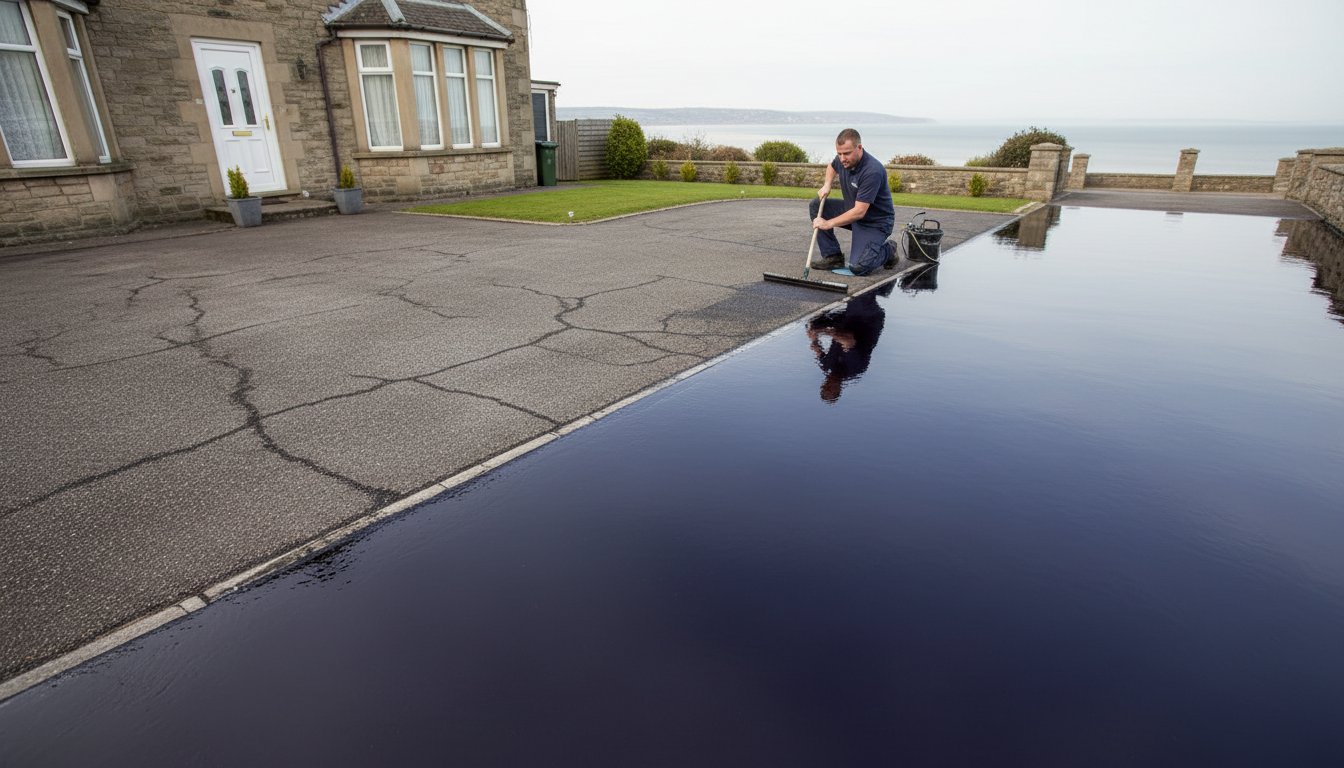
In January 2026, a homeowner in the Uplands district of Swansea watched as a minor hairline fracture transformed into a disruptive three-inch pothole following just fourteen days of heavy coastal rainfall. It’s a recurring narrative in South Wales, where the local climate’s 1,000mm of annual precipitation can accelerate the decay of any surface that lacks professional oversight. You likely recognise that a driveway is the foundational handshake of your property, yet seeing it marred by unsightly cracks and tripping hazards is deeply frustrating. Choosing a professional tarmac driveway repair is about more than aesthetics; it’s a commitment to the enduring legacy and structural health of your residence.
This case study demonstrates how bespoke restoration preserves your home’s market value and ensures a smooth, resilient finish that withstands the elements. We’ll examine the technical causes of tarmac failure and provide a clear roadmap for selecting a visionary contractor who prioritises craftsmanship over quick fixes. By understanding the precision required for a durable result, you can transform a source of stress into a testament to your property’s long-term excellence.
Key Takeaways
- Understand how Swansea’s unique maritime climate necessitates a structural approach to tarmac driveway repair, ensuring your property’s foundation remains resilient against heavy rainfall.
- Identify the mechanics of ‘ravelling’ and surface oxidation to prevent minor fissures from evolving into significant structural failures.
- Evaluate the long-term value of professional restoration versus temporary DIY patches, highlighting the importance of industrial-grade equipment in securing a lasting legacy for your home.
- Gain insights from a bespoke restoration in Mumbles, where advanced drainage solutions and precision craftsmanship transformed a weather-worn driveway into a statement of quality.
- Discover the Regal Group commitment to excellence, utilizing skilled in-house craftsmen to deliver restorations that enhance both property value and the local community.
Understanding Tarmac Degradation in Swansea’s Unique Climate
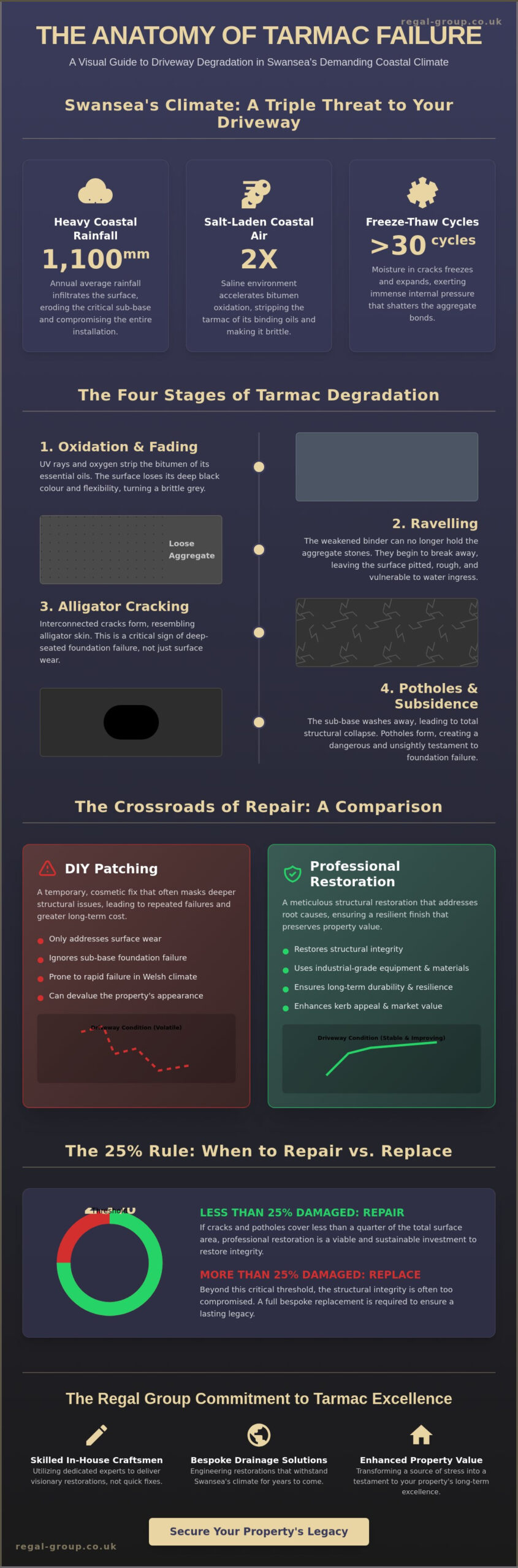
A professional tarmac driveway repair is far more than a cosmetic application of surface filler; it’s a meticulous structural restoration designed to preserve the architectural integrity of a property’s entrance. In Swansea, where the annual rainfall consistently averages around 1,100mm, the challenges facing domestic and commercial surfaces are uniquely demanding. This persistent hydration doesn’t simply rest on the surface. It infiltrates the asphalt concrete composition, gradually eroding the critical sub-base and triggering surface fretting that compromises the entire installation. When the foundation is weakened by hydraulic pressure, the surface loses its ability to support vehicular weight, leading to a cycle of decline that requires visionary intervention to reverse.
The proximity to the Bristol Channel introduces a secondary environmental threat in the form of salt-laden coastal air. This saline environment accelerates the process of bitumen oxidation, a chemical reaction that strips the tarmac of its essential oils and binding strength. Without these oils, the driveway loses its dark, lustrous finish and its ability to flex under pressure. It becomes a brittle relic of its former self, prone to shattering under the weight of modern SUVs or delivery vehicles. Maintaining the prestige of a Swansea home requires an understanding that the driveway is a living component of the built environment, one that demands constant protection from these maritime elements.
The Role of South Wales Weather in Surface Wear
The Gower Peninsula and the surrounding Swansea Bay area experience specific freeze-thaw cycles that test the limits of tarmac elasticity. When moisture enters microscopic fissures and expands as ice during the winter months, it exerts immense internal pressure on the aggregate. Older, non-porous tarmac surfaces are particularly vulnerable to standing water, which acts as a slow-acting solvent that dissolves the bond between stone and binder. Bitumen oxidation is the primary chemical cause of grey, brittle surfaces that have lost their original flexibility and resilience.
Common Signs Your Driveway Needs Professional Attention
Recognising the early warnings of failure is vital for any homeowner committed to the long-term value of their property. Identifying “alligator cracking” is a priority, as these interconnected patterns of small cracks reveal deep-seated foundation failure rather than simple surface wear. While minor scuffs are often superficial, structural potholes indicate that the sub-base has already begun to migrate or wash away entirely. Fading colour is more than an aesthetic decline; it’s a clear signal that the protective bitumen has vanished, leaving the aggregate exposed to the harsh Welsh weather. Professional tarmac driveway repair remains a viable, sustainable investment until the damage covers more than 25% of the total surface area. Beyond this critical threshold, the structural integrity is often too compromised for restoration, necessitating a full bespoke replacement to ensure a lasting legacy.
The Anatomy of Tarmac Failure: Cracks, Potholes, and Fading
Tarmac isn’t a static surface; it’s a complex, flexible composite that reacts to the volatile Welsh climate. When a driveway begins to fail, the visible symptoms are often the final stage of a long internal decline. The process usually begins with oxidation. As UV rays and oxygen strip the bitumen of its essential oils, the surface loses its elasticity and turns from a deep obsidian to a brittle grey. This brittleness leads to “ravelling,” a mechanical failure where the aggregate stones lose their bond and begin to break away, leaving the surface pitted and vulnerable.
The true catalyst for total failure is water ingress. Once a hairline fracture appears, rainwater penetrates the surface and reaches the sub-base. In Swansea, where winter temperatures frequently fluctuate, the freeze-thaw cycle expands these cracks with surgical precision. A professional tarmac driveway repair focuses on more than just the surface. It addresses the sub-base, which serves as the structural skeleton of the entire installation. If the foundation is compromised by moisture or poor compaction, no amount of surface treatment will prevent future subsidence. A visionary approach to restoration treats the driveway as a singular engineering project, requiring a forensic diagnosis before any materials are laid.
Why DIY Patches Often Fail Within Six Months
The retail market is flooded with cold-lay tarmac bags, yet these solutions rarely survive a single season of heavy residential use. Cold-lay materials don’t achieve the same density as hot-mix bitumen, often remaining porous and unstable. When a homeowner fills a hole without cutting back the edges to sound material, they create a weak “cold joint” that invites water to seep back in. Professional restoration relies on thermal bonding and specific professional pothole repair procedures to ensure the new material fuses with the old. Without this molecular bond, the patch remains a temporary plug rather than a permanent architectural fix.
The Science of Bitumen Restoration
True regeneration involves chemistry, not just aesthetics. While “tarmac paint” provides a brief cosmetic lift, it fails to address the underlying structural decay. High-end restorers use penetrative bitumen binders that soak into the existing surface to replace lost maltenes and asphaltenes. This process restores the tarmac’s original flexibility, preventing future cracks from forming. Achieving a seamless finish requires a bespoke approach to texture matching, ensuring the repaired areas blend perfectly with the original driveway. For those seeking to preserve the long-term value of their property, a bespoke restoration plan is the only way to ensure the tarmac driveway repair stands as a testament to quality craftsmanship.
- Structural Integrity: We assess the sub-base density to prevent future sinkage.
- Edge Saw-Cutting: Every repair starts with clean, vertical edges for maximum bonding.
- Binder Rejuvenation: We use industrial-grade resins that outperform standard DIY sealants.
Professional Restoration vs. DIY Patching: A Comparison
Choosing between a weekend DIY project and a professional tarmac driveway repair is the fundamental difference between a temporary bandage and a visionary investment in your home’s legacy. While cold-lay bags found at local hardware stores offer a seductive price point, they lack the thermal bonding properties required to withstand the heavy rainfall and coastal humidity typical of South Wales. These retail products are often porous, leading to rapid water ingress and subsequent freeze-thaw cracking within a single season.
Professional restoration utilizes hot-applied bitumen at temperatures exceeding 160°C. This ensures a seamless molecular bond with the existing substrate. Technical standards supported by the Asphalt Pavement Alliance emphasize that mechanical compaction is the cornerstone of pavement longevity. Regal Group’s in-house teams employ heavy-duty vibrating rollers to achieve a density that manual hand-tamping simply cannot replicate. Unskilled labor often overlooks the essential sub-base engineering, leading to structural shifting that ruins the surface finish in under 18 months.
The True Cost of Driveway Maintenance
Short-term savings frequently mask long-term financial erosion. Patching a driveway annually with inferior materials costs roughly 35% more over a five-year cycle than a singular, high-specification restoration. We find that the tarmac driveway cost Cardiff and Swansea homeowners encounter is an honest reflection of the engineering precision beneath the surface. In the current 2026 market, a flawlessly executed driveway can increase property valuations by an estimated 5% to 10%, transforming a functional necessity into a tangible financial asset. It’s an exercise in visionary stewardship rather than mere maintenance.
Aesthetic Integrity and Curb Appeal
Visual coherence defines the prestige of premier Swansea neighborhoods like Sketty and Derwen Fawr. A “patchwork” driveway suggests neglect and architectural discord, whereas a uniform, professionally restored surface projects an image of meticulous stewardship. Our repair techniques are designed to integrate flawlessly with high-end features, such as the resin driveways Swansea residents often utilize for decorative borders. If you’re weighing your options for a complete surface overhaul, our detailed guide on the tarmac vs resin driveway comparison for Swansea homes in 2026 provides the definitive analysis of both materials. We don’t just fill holes; we restore the property’s original grandeur. This commitment to craftsmanship ensures your home maintains its status within the local landscape while providing a smooth, resilient surface for decades to come.
Case Study: Transforming a Weather-Worn Driveway in Mumbles
In early 2025, Regal Group undertook a significant restoration project in the coastal village of Mumbles, where a 15-year-old driveway had reached a critical point of failure. The surface displayed severe oxidation, turning the once-rich black tarmac into a brittle, grey expanse prone to crumbling. Our initial technical assessment identified that the primary culprit wasn’t just age. Poor drainage had allowed water to permeate the sub-base, leading to instability and several deep potholes that threatened the structural integrity of the entire entrance. We approached this project not as a simple patch job, but as a bespoke piece of urban regeneration.
Step 1: Precision Groundworks and Preparation
Success in any tarmac driveway repair lies in the unseen preparation. Our team began by saw-cutting the edges of the damaged areas, creating a vertical “key” that ensures the new material locks firmly into the existing structure. We cleared years of moss, lichen, and accumulated debris using high-pressure thermal systems to ensure the surface was perfectly clean. Our technicians executed the cleaning phase with a level of meticulous attention that treated the driveway as a canvas, ensuring every square inch was primed for maximum binder adhesion. This foundational work is what separates a temporary fix from a lasting legacy of craftsmanship.
Step 2: The Hot-Lay Application and Compaction
We utilized a high-specification hot-mix tarmac, applied at precise temperatures to ensure a seamless chemical bond with the original surface. This wasn’t just about aesthetics; it was about engineering. By carefully recalculating the surface levels, we eliminated previous water pooling issues that had plagued the property for over 5 years. The process concluded with the application of a high-performance bitumen restorer. This specialist treatment replenishes the essential oils within the tarmac, effectively reversing the aging process and restoring that deep-black lustre synonymous with prestige properties.
The Final Reveal: Longevity and Client Satisfaction
The result was a total transformation that contributed significantly to the local Mumbles streetscape. The client remarked that the tarmac driveway repair provided a “new build” feel, instantly elevating the property’s market value. By resolving the sub-base drainage issues, we’ve extended the driveway’s functional life by an estimated 12 to 15 years. Understanding how long does tarmac take to dry in Swansea’s coastal climate was a key factor in scheduling the project correctly and ensuring the client could use their driveway without risk of damage. At Regal Group, we take quiet pride in these transformations, knowing our work sustains the beauty and utility of the Swansea coastline for the long term.
Ensuring Longevity: The Regal Group Approach to Tarmac Excellence
True tarmac driveway repair is an act of preservation. At Regal Group, we view every Swansea home as a vital piece of the city’s architectural heritage. Our approach transcends simple patching; we implement comprehensive restoration strategies designed to endure the unique pressures of the South Wales climate. We act as the guardians of Swansea’s outdoor environments, ensuring that every square metre of asphalt contributes to a more beautiful, sustainable urban landscape. By prioritising structural integrity over quick fixes, we protect your property’s value for decades.
Our Signature Restoration Process
Quality remains our singular obsession. We refuse to delegate our reputation to subcontractors, choosing instead to rely exclusively on our permanent, in-house team of skilled craftsmen. This commitment ensures total accountability and a level of finish that external crews simply cannot replicate. Our artisans select high-polymer modified binders and high-end aggregates specifically chosen to resist the coastal salinity and heavy rainfall typical of the Gower and Mumbles regions. By integrating the core principles of outdoor renovation South Wales, we ensure your driveway isn’t just repaired, but fundamentally regenerated. This includes the installation of bespoke drainage solutions that exceed standard building regulations, preventing the hydraulic pressure that often leads to surface failure.
- In-house Artisans: Every technician is a full-time Regal Group employee trained in advanced thermal bonding techniques.
- Coastal Grade Materials: We utilise stone mastic asphalt (SMA) variants that offer superior resistance to the freeze-thaw cycles of the Welsh winter.
- Visionary Drainage: Our custom-engineered soakaways and linear drains are designed to handle the 1,400mm of annual rainfall Swansea often receives.
Your Journey to a Restored Driveway
The transition from a weathered surface to a pristine entrance is seamless with our refined consultation process. We provide Swansea residents with a transparent, free quotation that reflects the true scope of a professional tarmac driveway repair. During our initial visit, you’ll experience a level of honesty and technical expertise that defines our brand. We don’t just look at cracks; we analyse sub-base health and topography to provide a visionary plan for your home’s exterior. To maintain this excellence, we offer scheduled professional inspections that future-proof your investment against the elements.
Your home deserves a foundation that reflects its prestige. Don’t settle for temporary solutions that fail within a single season. Contact our team today to secure your property’s legacy with a professional assessment. Let’s build a future where your driveway remains a testament to quality craftsmanship and enduring style.
Securing the Longevity of Your Swansea Estate
A driveway is more than a functional surface; it’s the first chapter of your home’s story. In the face of the salt-rich air and high rainfall levels typical of the South Wales coast, maintaining this narrative requires more than just a temporary fix. Our 2026 restoration work in Mumbles demonstrates that true tarmac driveway repair transcends simple patching. It involves a deep understanding of structural integrity and an uncompromising commitment to craftsmanship. By choosing professional restoration, you ensure your property remains a testament to quality rather than a victim of coastal erosion.
Regal Group manages every stage of this transformation with a dedicated in-house team. We don’t believe in the diluted quality of subcontractors. Instead, we offer bespoke surfacing solutions that respect the heritage of your property while utilizing modern, resilient materials. Our expertise in navigating the specific climatic challenges of Swansea ensures your investment is protected for the long term. We take total ownership of your project from the initial consultation to the final finish.
Request your bespoke tarmac restoration quote from Swansea’s leading experts
Your home deserves a foundation that matches its ambition.
Frequently Asked Questions
Is it better to repair or replace a tarmac driveway?
The decision depends entirely on the structural integrity of the sub-base and the extent of surface degradation. If less than 25% of the surface shows signs of wear, a professional tarmac driveway repair is a sustainable and cost-effective way to restore the aesthetic appeal of your property. However, if deep foundational cracks appear across more than 35% of the area, a full replacement ensures a more reliable long-term legacy for your home.
How much does professional tarmac driveway repair cost in Swansea?
According to 2024 industry benchmarks for South Wales, professional repairs typically range from £50 to £95 per square metre. These costs vary based on the specific bitumen grade required and the complexity of the excavation. Investing in high-quality restoration prevents the need for a total overhaul, which often costs upwards of £2,500 for a standard two-car driveway in the Swansea area.
Can you put new tarmac over old tarmac?
Overlaying is a sophisticated restoration technique, but it’s only successful if the existing foundation remains stable and free from significant subsidence. This process involves applying a bespoke 25mm to 35mm layer of fresh material directly over the prepared old surface. It’s an efficient way to achieve a visionary finish without the environmental impact or disruption of a full-scale demolition.
How long does a tarmac repair take to set?
Fresh tarmac requires 24 hours to cure before it’s ready for pedestrian traffic, while vehicles should be kept off the area for at least 48 to 72 hours. In the humid coastal climate of Swansea, the material continues to harden for up to 12 months as the volatile oils evaporate. For a comprehensive breakdown of the full curing timeline and what to expect at each stage, our guide on how long does tarmac take to dry in Swansea’s coastal conditions provides detailed guidance. You should avoid turning car wheels while stationary during the first 14 days to prevent scuffing the pristine new surface.
Why is my tarmac driveway cracking and crumbling?
Cracking is usually the result of UV oxidation, which strips the bitumen of its natural flexibility and leaves the surface brittle. When the binder fails, water penetrates the gaps; this is particularly damaging in Wales where the freeze-thaw cycle expands those cracks rapidly. Addressing these minor fissures early preserves the structural integrity of the urban environment and prevents a total collapse of the driveway’s surface.
Can I use a tarmac restorer on my own?
Retail products are available for minor touch-ups, but they often lack the high-polymer density found in professional-grade restorative coatings. Our artisans use industrial sealants that chemically bond with the aggregate to create a seamless, durable barrier against the elements. A professional application ensures a bespoke finish that lasts up to five times longer than standard DIY alternatives.
What is the best time of year to repair a tarmac driveway in Wales?
The most successful tarmac driveway repair projects take place between April and September when temperatures consistently stay above 10 degrees Celsius. Bitumen requires ambient warmth to remain workable and achieve a superior bond with the existing substrate. Planning your restoration during these drier months ensures the material sets correctly, protecting your investment from the unpredictable Welsh rainfall.
How do I stop weeds growing through my tarmac driveway?
Weeds typically thrive when organic matter collects in untreated cracks, rather than pushing up from the soil beneath. You can eliminate this growth by ensuring every fissure is professionally filled and the entire surface is treated with a high-quality acrylic sealant. Maintaining this impenetrable barrier preserves the clean, sophisticated lines of your entrance and prevents roots from compromising the driveway’s structural integrity.