


A single night of sub-zero temperatures in South Wales can inflict more structural damage on a bespoke driveway than an entire decade of heavy vehicle use. With Swansea historically experiencing over 30 days of ground frost during the colder months, the risk of moisture penetrating your surfaces is a constant reality. You’ve likely invested significant capital to ensure your home makes a lasting impression, yet the local climate often threatens that very foundation. Mastering winter driveway care is the only way to safeguard your property’s architectural integrity while ensuring your family remains safe on every journey.
Our 2026 professional checklist offers a refined approach to maintenance that balances sophisticated aesthetics with practical safety. You’ll gain the confidence to manage South Wales’ unique coastal frosts using methods that protect your investment’s long-term value and kerb appeal. We’ll outline a meticulous maintenance schedule and reveal which specific de-icers maintain surface quality, ensuring your driveway emerges in spring looking as immaculate as the day it was first installed.
Key Takeaways
- Understand how Swansea’s unique coastal humidity and salt-laden air accelerate material degradation, and why proactive preservation is essential for your home’s kerb appeal.
- Master a professional five-step audit to identify hairline fractures and clear organic debris before the first frost compromises your driveway’s structural integrity.
- Discover bespoke maintenance strategies tailored to your specific surface, including how resin-bound systems leverage superior porosity to mitigate the impact of Welsh frost.
- Learn to implement a sophisticated ice management strategy that utilizes non-corrosive de-icing alternatives to protect the chemical bond of luxury surfaces.
- Explore how professional engineering and expert assessments ensure your winter driveway care routine secures a lasting architectural legacy for decades to come.
The Swansea Winter Challenge: Why Proactive Driveway Care Matters
Effective winter driveway care represents far more than seasonal maintenance; it’s the strategic preservation of a home’s architectural threshold. For residents in Swansea, this process involves defending surfacing materials against the relentless ingress of moisture and the destructive nature of local weather patterns. A driveway serves as the opening narrative of a property’s aesthetic, often contributing up to 10% of a home’s total market valuation according to recent UK property surveys. Neglecting this asset during the colder months risks compromising the structural integrity that defines a luxury residence.
The primary antagonist in this coastal environment is the freeze-thaw cycle. When temperatures drop, water trapped within microscopic fissures expands by approximately 9% in volume. This physical expansion exerts immense internal pressure, widening cracks and destabilising the surface. Understanding how de-icing agents work is essential for homeowners who wish to mitigate these risks without causing secondary chemical damage to their bespoke installations. Without a proactive approach, these micro-cracks evolve into significant structural failures by spring.
Understanding the Impact of South Wales Precipitation
Swansea records an average annual rainfall exceeding 1,100mm, a figure that places significant stress on domestic drainage systems. During winter, this high volume of precipitation makes efficient water runoff the most critical factor in driveway longevity. Standing water doesn’t just sit on the surface; it permeates the sub-base, leading to “pumping” where the foundation loses its ability to support heavy vehicles. The coastal air adds another layer of complexity. Salt-laden winds from the Bristol Channel carry sodium chloride, which reacts chemically with traditional aggregates and binders, accelerating the erosion of the driveway’s finish.
The Cost of Neglect vs. the Value of Preservation
The financial disparity between proactive winter driveway care and reactive repair is stark. A routine professional cleaning and sealing service costs a fraction of the investment required for a full structural resurfacing, which can easily reach several thousand pounds for a premium installation. Many high-end surfacing warranties specifically exclude damage caused by preventable ice expansion or the use of corrosive chemicals.
At Regal Group, we view craftsmanship as a commitment that extends through every season. We believe that true luxury is found in longevity, ensuring your property remains a visionary statement of quality regardless of the Welsh winter. Preservation isn’t just about saving money; it’s about protecting a legacy of architectural excellence. By investing in the integrity of your driveway today, you’re securing the future value and curb appeal of your home for years to come.
The Pre-Winter Preservation Checklist: 5 Essential Steps
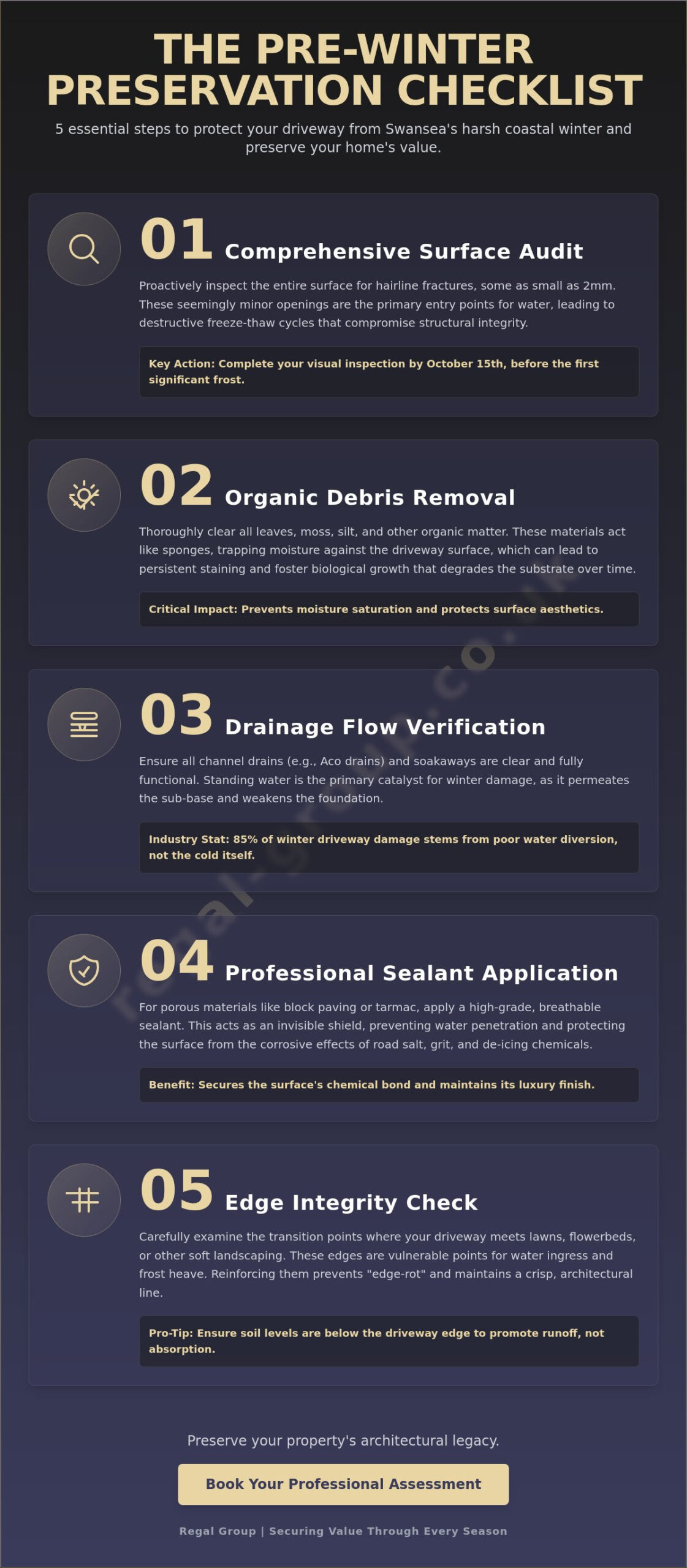
Effective winter driveway care starts long before the first frost settles over the Gower Peninsula. To preserve the structural integrity and aesthetic prestige of your property, a proactive approach is required. This five-step checklist ensures your driveway remains a testament to quality throughout the harshest months.
- Comprehensive Surface Audit: Inspect the entire area by October 15th to identify hairline fractures as small as 2mm. These minor openings allow water ingress, which leads to destructive freeze-thaw cycles when temperatures dip.
- Organic Debris Removal: Clear all leaves, moss, and silt. These materials act as sponges; they trap moisture against the surface and cause lasting stains or biological growth that compromises the substrate.
- Drainage Flow Verification: Test Aco drains and soakaways with a high-volume water test. Industry data suggests that 85% of winter driveway damage stems from poor water diversion rather than the cold itself.
- Professional Sealant Application: Apply a high-grade barrier to porous materials. This acts as a visionary shield against the corrosive effects of salt, grit, and ice.
- Edge Integrity Check: Examine the transitions where the driveway meets soft landscaping. Reinforcing these points prevents “edge-rot” during the sustained heavy rains common in South Wales.
Identifying and Repairing Early Warning Signs
Spotting “ravelling” in tarmac, where the surface aggregate begins to separate, is critical for long-term preservation. In block paving, look for “potholing” or slight sinking in high-traffic zones. Addressing these issues immediately prevents a minor repair from becoming a full-scale reconstruction. Before applying any protective treatments, ensure the surface is pristine. You can learn how to clean a driveway oil stain to remove deep-set contaminants that might compromise sealant adhesion and cause premature peeling.
The Art of Professional Surface Sealing
The Swansea climate demands a sophisticated choice between topical sealants and penetrating impregnators. While topical layers provide a glossy finish, penetrating solutions soak deep into the substrate to provide internal protection. This is particularly relevant when maintaining porous asphalt in winter, as internal drainage paths must remain clear of debris. Late autumn is the golden window for application; temperatures between 10°C and 20°C ensure the chemical bond sets perfectly. This meticulous attention to detail is what keeps resin driveways in Swansea looking vibrant for decades. If you’re unsure about your driveway’s current resilience, requesting a professional assessment can provide the bespoke insight needed for your specific site conditions.
Material-Specific Winter Strategies: From Resin to Tarmac
Effective winter driveway care requires an understanding of the specific chemistry and structural composition of your chosen surface. Swansea’s maritime climate creates a cycle of dampness and sudden frosts that tests the integrity of even the most prestigious installations. By tailoring your maintenance routine to the material of your home’s exterior, you preserve both the aesthetic appeal and the long-term value of your property. Each material reacts differently to the Welsh winter, demanding a bespoke approach to preservation.
Protecting Your Resin-Bound Investment
Resin-bound systems are naturally frost-resistant due to their visionary porous structure. This allows water to drain through to the sub-base rather than sitting on the surface to freeze into hazardous ice sheets. However, maintaining this permeability is essential. Organic debris can settle in the voids, creating a mulch that holds moisture and invites frost damage. Use a stiff brush to clear leaves regularly. If snow accumulates, always reach for a plastic shovel. Metal edges can gouge the handcrafted finish, compromising the resin’s protective seal. For homeowners dealing with ‘blushing’ or white spots, this often indicates moisture trapped during a substandard installation. These spots require professional attention to restore the clear, vibrant finish that defines a high-end resin driveway.
Maintaining Tarmac and Asphalt Integrity
Tarmac becomes increasingly brittle as temperatures drop toward zero degrees. Oxidation is a constant threat in winter, as the bitumen binder loses its flexibility and becomes prone to ‘heave’ from thermal expansion. You should avoid turning your vehicle’s wheels while the car is stationary; this static friction can scuff the hardened surface and create permanent divots. Many homeowners are unaware of the dangers of deicing salts, which can penetrate small fissures and accelerate the crumbling of the aggregate. If your tarmac has faded to a dull grey, a professional rejuvenation treatment can seal minor cracks and restore the deep, charcoal lustre that complements a modern Swansea residence.
Block Paving and Natural Stone Resilience
The strength of block paving lies in the friction provided by kiln-dried sand within the joints. Heavy winter rainfall in South Wales often washes this sand away, leaving the blocks vulnerable to shifting and structural instability. This loss of stability also creates an opportunity for weed migration and moss growth, particularly in shaded garden areas. Regularly inspect your joints and top them up with sand to maintain structural harmony. If you’re concerned about persistent organic growth between your paving stones, our professional guide on how to stop weeds in block paving outlines the authoritative methods to eradicate unwanted growth and protect your investment through the winter months. For residents considering a more significant material upgrade, exploring options for outdoor renovation in South Wales can provide a more resilient foundation for the years ahead. Preventing algae is a matter of hygiene; a gentle wash with a pH-neutral cleaner will keep your natural stone looking pristine without damaging its mineral composition.
Active Winter Management: Snow, Ice, and Drainage Control
Effective winter driveway care in Swansea’s coastal climate demands a proactive strategy that prioritises surface integrity alongside safety. The goal is to manage the elements without compromising the meticulous chemical bond of your driveway’s finish. A well-executed management plan ensures that the visual prestige of your home remains untarnished even during the harshest January frosts. It’s about protecting the long-term legacy of your property through disciplined maintenance.
The De-Icing Debate: What is Safe for Your Surface?
Traditional brown rock salt, while cost-effective for public highways, is often unsuitable for luxury residential surfaces. The iron oxide within the grit can leave permanent, unsightly brown stains on light-coloured resin or natural stone. For those seeking to preserve a pristine aesthetic, white marine salt offers a cleaner alternative that dissolves completely without leaving a gritty residue. You should strictly avoid de-icers containing ammonium nitrates on concrete-based products. These chemicals can trigger a rapid degradation of the surface through a process known as chemical attack, potentially reducing the lifespan of a standard concrete driveway by up to 15% over a single decade. Instead, opt for non-corrosive acetate-based products that protect both the stone and the surrounding environment.
Strategic Snow Removal Techniques
The secret to maintaining a flawless finish lies in the “clear-as-it-falls” rule. Allowing snow to accumulate leads to the formation of hard-packed ice “lenses” that are far more difficult to remove without damaging the underlying substrate. When clearing your path, always work with the “grain” or the natural lay of the surface. This technique prevents shovel edges from catching on paving stones or resin borders. If you use a snow blower, ensure it’s equipped with a rubber-edged auger to protect your bespoke investment from mechanical scarring. It’s a simple adjustment that preserves the kerb appeal you’ve worked hard to establish.
Monitoring drainage is particularly vital during the frequent yellow weather warnings issued by the Met Office for South Wales. Swansea’s climate data shows significant rainfall spikes that can overwhelm poorly maintained systems. You must ensure that all permeable channels and SuDS-compliant zones are free from debris to allow efficient runoff. This prevents standing water from entering a freeze-thaw cycle, which is the primary cause of structural cracking in older installations. A quick inspection after a storm can save thousands in repair costs later in the season.
Maintaining the legacy of your property starts with professional attention to detail. If you’re looking to upgrade your home’s exterior with a surface built for longevity, explore our bespoke driveway solutions.
Securing the Legacy: Professional Support and Next Steps
While routine maintenance preserves the surface, a professional assessment serves as the ultimate safeguard for your home’s external environment. True winter driveway care extends beyond the seasonal application of grit. It requires an expert eye to identify microscopic shifts in the sub-grade before they manifest as structural failures. Regal Group views every driveway as a vital component of Swansea’s urban fabric; we ensure your investment remains a source of pride rather than a future liability. By engaging with specialists who understand the specific geological challenges of South Wales, you protect the architectural integrity of your entire property.
The Regal Group Standard of Engineering
We engineer every installation to withstand 20+ winters by focusing on the unseen foundation. The sub-base acts as the critical barrier against the freeze-thaw cycles that often dismantle lesser builds. If the foundation is compromised, even the most expensive resin or stone will fail. Our strict no-subcontractor policy guarantees that our in-house artisans maintain total accountability for every millimetre of material. We don’t outsource our reputation. This end-to-end involvement ensures that the craftsmanship you see on the surface is matched by the technical precision beneath it. Our portfolio across Swansea features projects completed in 2015 that still possess their original structural integrity today. We invite you to explore these durable, winter-ready installations to see how bespoke engineering translates into long-term value.
Planning Your 2026 Outdoor Transformation
- Audit drainage performance: Observe runoff patterns during heavy February downpours.
- Assess surface texture: Check for any loss of aggregate or thinning of sealants.
- Consult the experts: Secure your place in our 2026 spring schedule to avoid the seasonal rush.
Protecting Your Property’s Legacy Beyond 2026
Maintaining a pristine entrance requires more than just reactive clearing; it demands a strategy built on the specific climatic demands of South Wales. By adhering to a rigorous pre-winter checklist and choosing materials engineered for the high humidity levels typical of the Swansea coastline, you ensure your investment remains a point of pride. Effective winter driveway care is about foresight. It’s the difference between a surface that merely survives and one that thrives. This proactive approach protects the structural integrity of your home while maintaining its aesthetic prestige during the coldest months.
Regal Group brings a visionary approach to every project, ensuring your exterior reflects the same quality as your interior. Our expert in-house team handles every aspect of the process, as we never use subcontractors to deliver our work. We utilize high-end surfacing specifically engineered to endure the unique Welsh elements, backed by comprehensive 10-year guarantees on all new installations. Secure your property’s future with a bespoke driveway consultation from Regal Group. Your home deserves a foundation that stands the test of time and season.
Frequently Asked Questions
Is rock salt safe to use on my resin-bound driveway in Swansea?
White de-icing salt is safe for your resin-bound surface, though you should avoid traditional brown rock salt which often leaves unsightly iron oxide stains. While the permeable nature of resin allows for natural drainage, a light application of salt prevents ice film from forming during Swansea’s 30 to 40 annual frost days. Once the temperature rises, simply wash the residue away with clean water to maintain the pristine aesthetic of your bespoke installation.
How often should I seal my tarmac driveway to protect it from winter frost?
You should apply a professional-grade sealant to your tarmac driveway every 24 to 36 months to ensure maximum protection against the freeze-thaw cycle. In South Wales, where winter rainfall can exceed 1,200mm annually, unsealed tarmac is vulnerable to water ingress that expands when frozen. This proactive winter driveway care preserves the structural integrity of the bitumen and prevents the surface from becoming brittle or losing its deep, architectural finish.
Can the heavy winter rain in South Wales cause my driveway to sink?
Excessive rainfall can cause a driveway to sink if the sub-base wasn’t engineered to the 2008 Sustainable Drainage Systems (SuDS) standards. In Swansea, where intense winter storms can deliver 50mm of rain in 24 hours, poorly compacted foundations can wash away or shift. Professional installations utilize a Type 1 MOT base or permeable aggregates to ensure water manages its own path without compromising the land’s structural legacy.
What is the best way to remove thick ice from block paving without damaging the stones?
The safest method for removing thick ice from block paving is using a plastic-edged shovel followed by an application of white de-icing salt. Metal tools often chip the edges of the stones, permanently devaluing the craftsmanship of your entrance. For a more sustainable approach, use kiln-dried sand to provide immediate traction; it’s a method that respects the environment while ensuring the safety of your family and visitors throughout the winter.
Does winter weather affect the installation of a new driveway?
Winter weather significantly influences the timeline of a new driveway project, as most high-end materials require specific thermal windows for successful curing. For instance, tarmac requires an ambient temperature of at least 5 degrees Celsius to compact correctly. Our commitment to quality means we monitor local Met Office data daily, ensuring that every layer of your winter driveway care plan begins with a technically perfect installation that withstands the elements.
How do I know if a crack in my driveway is a serious structural issue or just cosmetic?
A crack exceeding 6mm in width or showing signs of vertical displacement usually indicates a serious structural failure in the sub-base. While fine hairline fractures are often cosmetic responses to temperature shifts, wider gaps allow water to reach the foundation, accelerating decay. Identifying these issues early is vital for the regeneration of your property’s exterior, as professional repairs prevent a localized flaw from becoming a total surface replacement.
Is it better to shovel snow or use a chemical de-icer on a luxury surface?
It’s always better to shovel fresh snow manually before it compacts into ice, as this reduces the need for aggressive chemical treatments. For luxury surfaces, we recommend using a rubber-edged snow pusher to protect the finish from abrasions. If ice persists, use a calcium magnesium acetate (CMA) de-icer; it’s 20 times less corrosive than standard salt and aligns with a visionary approach to long-term property preservation.
Can I install a new resin driveway during the winter months in Wales?
You can install a resin driveway in winter only when the ground is completely dry and the temperature remains above 5 degrees Celsius during the 24-hour curing period. High humidity levels, common in the coastal climate of South Wales, can cause the resin to bloom or cloud, ruining the bespoke aesthetic. We typically schedule these prestigious projects during dry spells to ensure the integrity and clarity of the finished architectural surface.